
It is a slow Thursday and you are cleaning out the inquiry binder on the front desk. Halfway down is a sticky note from last March: “Jenna, twins, wants infant spots for the fall, call back.” You never called back. It was the week two teachers quit and you were covering the toddler room yourself. Jenna enrolled somewhere else by April, and that note sat there for seven months like a receipt you forgot to cash.
Here is the part nobody tells you. You are sitting on dozens of Jennas. Every form fill that went nowhere, every tour never booked, every waitlist family who aged out while you were busy, all of it is still in your phone, your email, and that binder. This post is a system to win those families back on purpose, with texts and emails that run themselves. You already paid to get these leads, and reactivation is how you stop throwing them away.
What this post covers
- Why your old leads are worth more than new ones
- The six stages of a reactivation that works
- Steal these: the messages that bring them back
- Run it three ways: solo, mid-size, and a small chain
- The compliance part you cannot skip
- Objections I hear from directors
- Your questions, answered
Why your old leads are worth more than new ones
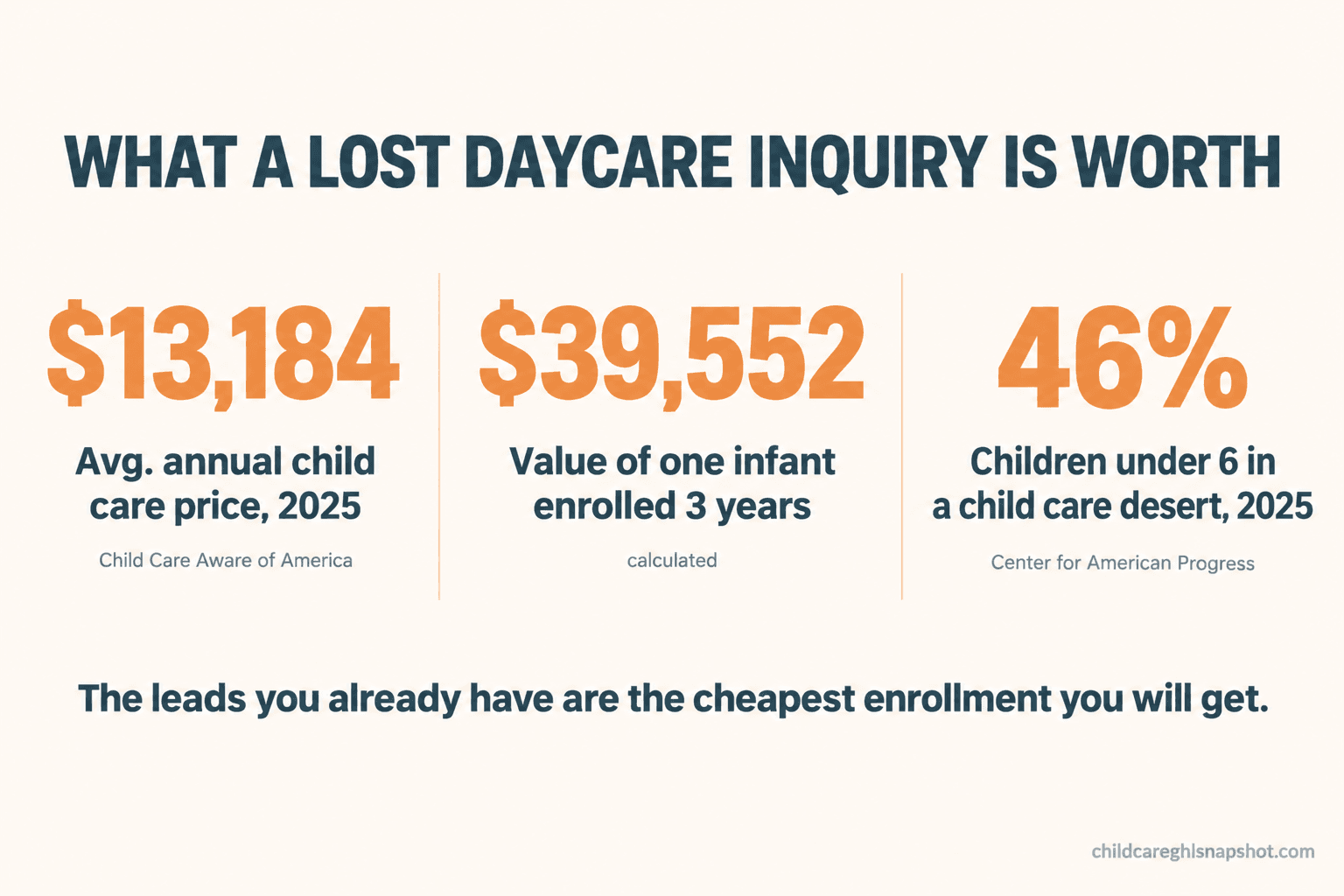
Do the math on Jenna. The national average price of child care in 2025 was $13,184 a year, per Child Care Aware of America, about $1,099 a month. A family that enrolls one infant and stays three years is worth $39,552 before a sibling, a referral, or the after-school years. Jenna had twins. That note decomposed on your front desk for seven months.
Now think about where new leads come from. An ad, a boosted post, the Google listing, a Saturday at a community fair: every one costs money or a weekend, and most people who respond are not ready. A parent who already inquired is different. She told you her child’s age, when she needed care, and that she was shopping. She pre-qualified herself months ago, and the only thing that went wrong is that nobody got back to her in time, the same leak behind why daycares lose enrollments to whoever calls back first.
And the demand has not dried up. About 46% of children under 6 still lived in a licensed child care desert in 2025, per the Center for American Progress, still nearly half the country. A cold lead is not a dead lead. It is a warm lead you let cool, and warming it back up costs a text message.
Relative likelihood of a qualifying conversation, indexed so replying a day later equals 1, from Harvard Business Review’s study of online sales leads: within an hour was about 7 times better than waiting an hour longer, and roughly 60 times better than waiting a day.
The six stages of a reactivation that works
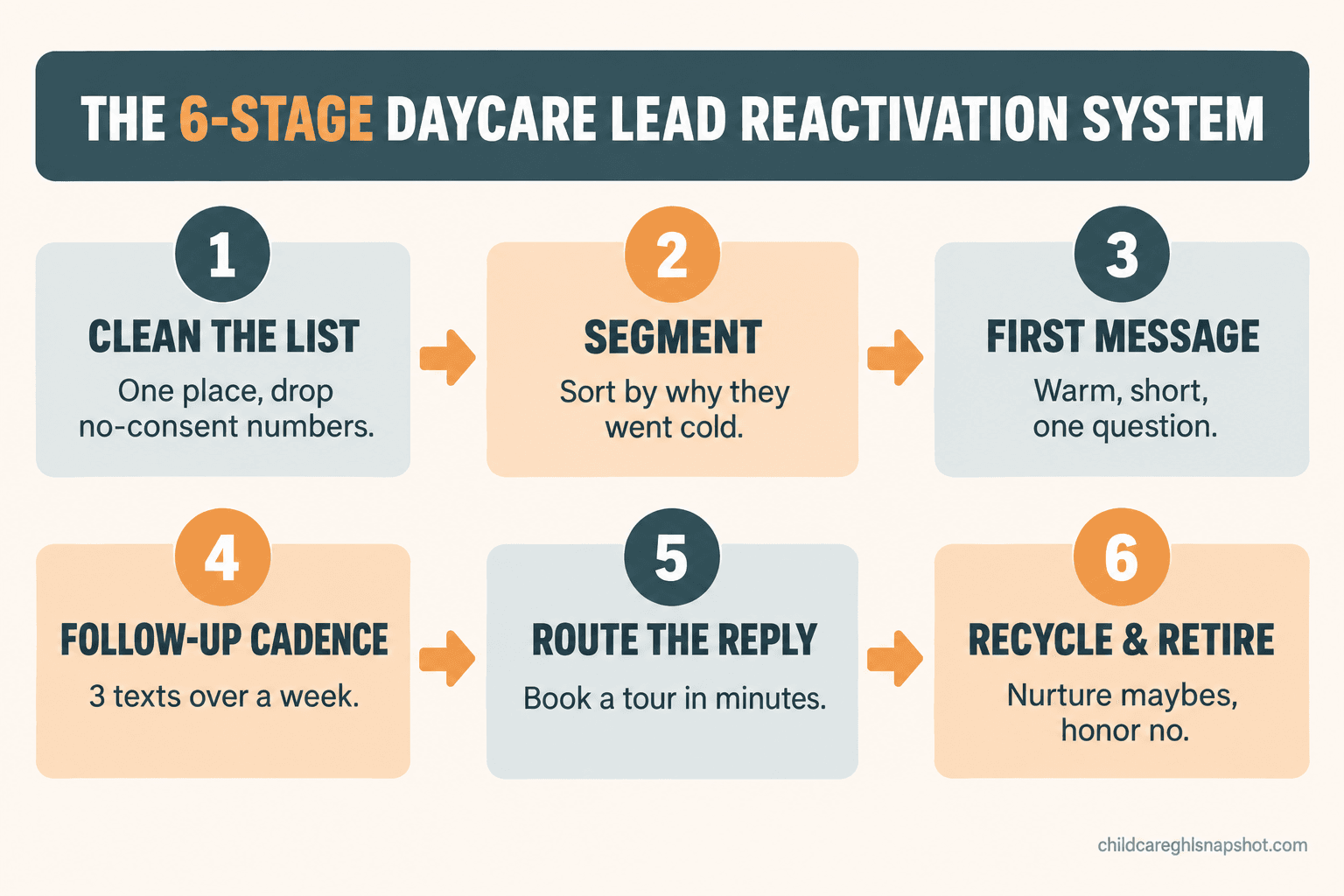
A reactivation is not “blast everyone a text and hope.” Done that way it annoys people, trips carrier filters, and burns your goodwill. The six stages each feed the next: set it up once and run it every quarter against whatever new pile has built up.
Stage 1: Pull the list and clean it
First you find every old inquiry in one place: Facebook page messages, website form fills, the voicemails you scrawled on sticky notes, Google Business Profile messages, and any spreadsheet a former front-desk person kept. Get them into one list with a name, phone, email, and what they wanted. Then clean it: drop duplicates, anyone who clearly enrolled elsewhere, and anyone who ever replied “stop.” You are not texting a bigger list, you are texting a cleaner one.
How this breaks: The classic mistake is reactivating a list you bought, scraped, or a vendor handed you. Those people never gave permission, and texting them is a straight TCPA violation, so only reactivate people who contacted you first. The second failure is keeping dead cell numbers in: they tank delivery and make carriers treat you like spam, so scrub the junk first.
Stage 2: Segment by why they went cold
Not every cold lead is cold for the same reason, and a one-size message reads like a form letter. Sort the clean list into a few buckets. The parent who inquired and never toured needs a different nudge than the one who toured, loved it, and then vanished (that one is its own problem, covered in why parents go quiet after a daycare tour). A third bucket is the waitlist family whose child aged past the spot they wanted. A fourth is the price-shopper who flinched at tuition. Four short buckets is plenty, and each gets an opener that speaks to its real reason.
How this breaks: Over-segmenting is as bad as not segmenting: build fourteen micro-groups and the campaign dies in a spreadsheet. When you are not sure why someone went cold, drop them in a neutral “general inquiry” group and let the opener ask instead of assume.
Stage 3: Send the first message that reopens the door
The first touch does the heavy lifting. It should sound like you remembered them, not like a marketing machine woke up. Short, warm, one question. You are not pitching tuition or features, you are checking whether they still need care. A good opener names the thing they asked about (“you reached out about infant care back in the spring”) and gives an easy way to say yes, no, or not yet. Text it if you have a mobile number and consent, and mirror it as an email for anyone you only have an address for.
How this breaks: The number-one killer is a wall of text. A parent reading on her phone between pickups will not read five sentences from a number she half-remembers, so keep it to two or three lines. The second killer is sending with no plan for replies: if the opener works, people answer within minutes, and a reply that sits for two hours re-loses the family you just woke up. Do not send until Stage 5 is ready.
Stage 4: Run a short, polite follow-up cadence
Most people do not answer the first message, and that is normal, so a reactivation is a short sequence. Three touches over about a week works well: the opener, a gentle bump two or three days later, and a final “should I close your file or keep your spot in mind” note near day seven. Change the wording each time and always give an easy out. You cannot predict when a parent has a free minute, so you show up a few times and then stop.
How this breaks: Daily texting is how you get reported and filtered. Carriers watch complaint rates under A2P 10DLC, and a pushy cadence gets your number throttled for everyone. Three touches, then stop. The other failure is never stopping: if someone has not replied after the sequence, they move to the “keep warm” email list in Stage 6, not another round of texts next week.
Stage 5: Route every reply to a real conversation, fast
When a parent answers, the automation’s job is done and a human’s job begins. The reply needs to land where a person sees it in minutes. Push the booking: offer two tour times or a self-scheduling link so she can pick a slot without phone tag. A confirmed tour with a reminder attached is the real win, the same way it works in the daycare enrollment funnel that fills seats. A reply is not a win. A booked tour is.
How this breaks: Speed is the whole game here. HBR’s data shows replying within the hour makes a qualifying conversation about 7 times more likely than waiting an hour longer. If replies route to a general email that gets read tomorrow, you have spent your goodwill to re-create the problem that lost the family the first time. Route replies to a phone someone watches, and have the daycare enrollment phone script ready so the person is not improvising.
Stage 6: Recycle the maybes, retire the no’s
Not everyone comes back, and that is fine. Sort the outcomes. Booked tours go into your normal tour flow, and hard no’s get marked and left alone forever. The large middle group, the “not right now” and the no-reply, moves to a slow email newsletter each month: an open-house invite, a spot-just-opened note, a re-enrollment nudge. A family that was not ready in March may be exactly ready in August. That is the same logic behind turning a daycare waitlist into enrolled families, applied to the people who never made it onto the list.
How this breaks: The failure is treating “no reply” as “no.” It usually means “not this week,” so those contacts belong in the slow nurture, not the trash. The opposite failure is keeping a real no on the texting list out of hope. When someone says they enrolled elsewhere or asks you to stop, honor it immediately and permanently. Respecting a no keeps your number trusted enough to reach the next Jenna.
Steal these: the messages that bring them back
Here is the actual copy. Change the names and the program details, keep the length and the tone.
Two rules carry this copy: use the director’s real first name, because a parent trusts “Ms. Dana” over “the Sunnyside team,” and never send a second message to someone who already replied.
Run it three ways: solo, mid-size, and a small chain
The same six stages scale, but the effort and the tools change with your size.
How reactivation changes with the size of your operation
| Plan | Solo (30-50 kids) | Mid-size (60-100 kids) | Small chain (2-3 sites) |
|---|---|---|---|
| Price | ~1 hour/quarter | ~3 hours/quarter | Ongoing, automated |
| Feature 1 | Pull list from one phone and one inbox | One shared inbox for all channels | Central database across all locations |
| Feature 2 | 2 or 3 buckets, done by hand | 4 buckets with saved message templates | Buckets by site and by program |
| Feature 3 | Director sends and replies personally | Front desk owns replies on a timer | Routing rules send a reply to the right site |
| Feature 4 | Email nurture: one monthly note | Automated 3-text cadence + monthly email | Dashboards track tours booked per campaign |
| Feature 5 | Biggest risk: no time to catch replies | Biggest risk: replies sitting too long | Biggest risk: a parent texted by two sites |
If you are solo, do not automate everything. Pull the list once a quarter, sort it into three buckets, and send the opener from your own phone. The trap is Stage 5: if you cannot watch the phone the next morning, do not send yet.
If you are mid-size, template it: one shared inbox, four saved openers, and one person answering replies within an hour. This is where a real system earns its keep, too much volume for sticky notes and too little to need an enterprise tool.
If you run two or three sites, it becomes an ongoing engine: a central database so the same parent is not texted twice, routing rules to the right site’s director, and a dashboard of tours booked per site. The compliance stakes are higher at real volume, because carriers are watching.
The compliance part you cannot skip
Reactivation touches a nerve normal marketing does not, because you are contacting people who went quiet. Get it right and it protects you. Get it wrong and a single complaint can cost you.
Texting consent is not forever, and it is not transferable. You can text a parent who gave you her mobile number to talk about care. You cannot text a number you bought, a number someone gave a different business, or one attached to a person who told you to stop. Under the TCPA, the sender has the burden of proving consent, and the FCC’s rules let a parent revoke it in any reasonable manner, including a plain “stop.” Honor every opt-out immediately and permanently, and for the full rundown read whether you can legally text daycare parents.
Register for A2P 10DLC before you send volume. US carriers filter business texts from regular ten-digit numbers unless the business and its campaign are registered through the A2P 10DLC system. Skip it and your texts get throttled or blocked, so you did the work for nothing. It is a one-time setup any platform worth using walks you through.
Keep child data out of marketing. State licensing rules, not FERPA, govern child-record confidentiality and photo consent for a private licensed daycare. Reactivation copy should never name or picture a specific child without written consent on file, and anything touching attendance or health data must stay in the parent-only channel and never feed your marketing list. A reactivation text is a “do you still need care” note, never a “here is a photo of the kids today” note.
Objections I hear from directors
“Isn’t it weird to text someone who inquired months ago?” It is weirder to let a family who wanted you enroll somewhere worse because nobody followed up. The opener names why you are reaching out and apologizes for the gap, which lands as human, not pushy. Most parents are relieved, and they still need care.
“Won’t I annoy people and get complaints?” Only if you do it wrong. Annoyance comes from daily texts, long messages, no opt-out, and ignoring replies. A three-touch cadence with an opt-out on the first text and a hard stop after day seven is the opposite, so respect the no’s and complaints are rare.
“I already pay for Brightwheel or Procare. Doesn’t that do this?” Those are parent-communication and billing tools for families already enrolled. They do not pull old inquiries, segment them, and run a cadence that books tours. Keep your check-in app and run reactivation beside it, the honest answer in what childcare software actually costs in 2026.
“Do I need to be technical?” No, but the plumbing has to be done right once: consent tracking, A2P registration, reply routing. That part is worth having built for you. After that, running a campaign is picking a list and clicking send.
Your questions, answered
How far back can I reactivate old daycare inquiries?
Go back as far as you have a real record of the person contacting you first, but be realistic. A six-to-twelve-month-old inquiry is a strong bet. Beyond about eighteen months, consent gets shaky and families have usually made other plans, so reach those by email, not text. Never text a number the person did not give you directly.
How often should I run a reactivation campaign?
Once a quarter suits most centers. It gives a fresh pile of inquiries time to build up and keeps you from texting the same people too often. A small chain with steady volume can run it as a continuous flow, where a lead that goes cold for 30 days drops in automatically.
Do I need A2P 10DLC registration just to text a few old leads?
If you are sending business texts from a ten-digit US number through an automation platform, yes. Carriers filter unregistered A2P traffic no matter how small your list is, so an unregistered campaign often means your texts silently fail to deliver. It is a one-time setup and cheap deliverability insurance.
What response rate should I expect from a reactivation campaign?
It varies too much to promise a number, and anyone who guarantees one is selling you something. The economics are what is reliable: these are leads you already paid to acquire, so even a few booked tours from a list you would have ignored is close to free enrollment. Measure tours booked, not reply rate.
How do I avoid texting a parent who already enrolled with me?
Clean the list before every send. Cross-check it against your enrolled families and active waitlist, and pull anyone already in the building or on the list. The embarrassing failure is texting a current parent 'do you still need care,' so a two-minute scrub against your roster is worth it every time.
So go find your binder: the sticky note from last March, the form fills nobody answered, the waitlist that aged out. That is not clutter, it is next quarter’s enrollment sitting in a drawer. Jenna with the twins enrolled somewhere else, and you cannot get her back. But the next Jenna is still in your files, still looking, one warm text away from a tour. The only thing that lost her the first time was silence. A reactivation system is how you make sure silence never costs you a family again.