

It is Thursday and you are thinking about the Hendersons. They toured on Monday. The mom held the baby the whole time, teared up in the infant room, and said, “This feels right.” You shook hands, sure it was a yes. It is three days later and she has not replied to your text. Not a no, just nothing.
You have a version of the Hendersons every week. The tour goes well, the family seems ready, then they disappear into silence. Here is the short version. A parent going quiet after a tour is almost never a rejection, it is a gap in follow-up. Families who tour are getting busy, comparing centers, waiting on a partner, or quietly panicking about the cost. If nobody guides them through that week, the tour that felt like a yes fades into a maybe, then into whoever called them back first.
What this post covers
- What the silence actually costs you
- Why parents really go quiet after a tour
- The post-tour follow-up system
- Stage 1: The same-day recap
- Stage 2: The day-two value message
- Stage 3: The one-week check-in
- Stage 4: The decision nudge with a deadline
- Stage 5: The hold-your-spot offer
- Stage 6: The long game for “not yet” families
- Run it three ways
- The compliance part you cannot skip
- The objections I hear from directors
- Your questions answered
What the silence actually costs you
A quiet family is not a small loss. The national average price of child care hit $13,128 a year in 2024, Child Care Aware of America reported. Families enroll for years, so one who stays from infancy through preschool is worth $26,000 to $39,000 in tuition. When the Hendersons go quiet, you are not losing a phone call, you are losing a seat that could pay a big part of a teacher’s salary.
What one enrolled family is worth over time, at the 2024 national average price of child care. Source: Child Care Aware of America, 2024 Price & Supply.
And the demand is there. About 46 percent of children under age 6 lived in a licensed child care desert in 2025, the Center for American Progress reported, and the Bipartisan Policy Center counts roughly 4.2 million children who lack a formal child care spot. Ready parents who toured and felt good are the least scarce thing you have. The follow-up is what is missing.
The worst part is you never see it on a report. A family that goes quiet just becomes a classroom that stays one child short, and you tell yourself they found somewhere closer. Some did. Many just never heard from you again.
Why parents really go quiet after a tour
When I ask directors why a family went dark, they say “they must not have liked us.” In eleven years running a center, that was almost never it. Here is what actually drove the silence, and what each one needs from you.
| Why they went quiet | What it needs from you |
|---|---|
| Life got busy after a good tour | A gentle reminder at the right time |
| Comparing you to two other centers | A reason you are the right choice, in writing |
| Waiting on a partner who did not tour | Something forwardable for dinner |
| Price shock once the number sank in | Value framed against cost, plus payment options |
| Decision paralysis over a big choice | A clear next step, not “let me know” |
| A logistics worry (start date, subsidy) | A direct answer to the thing holding them up |
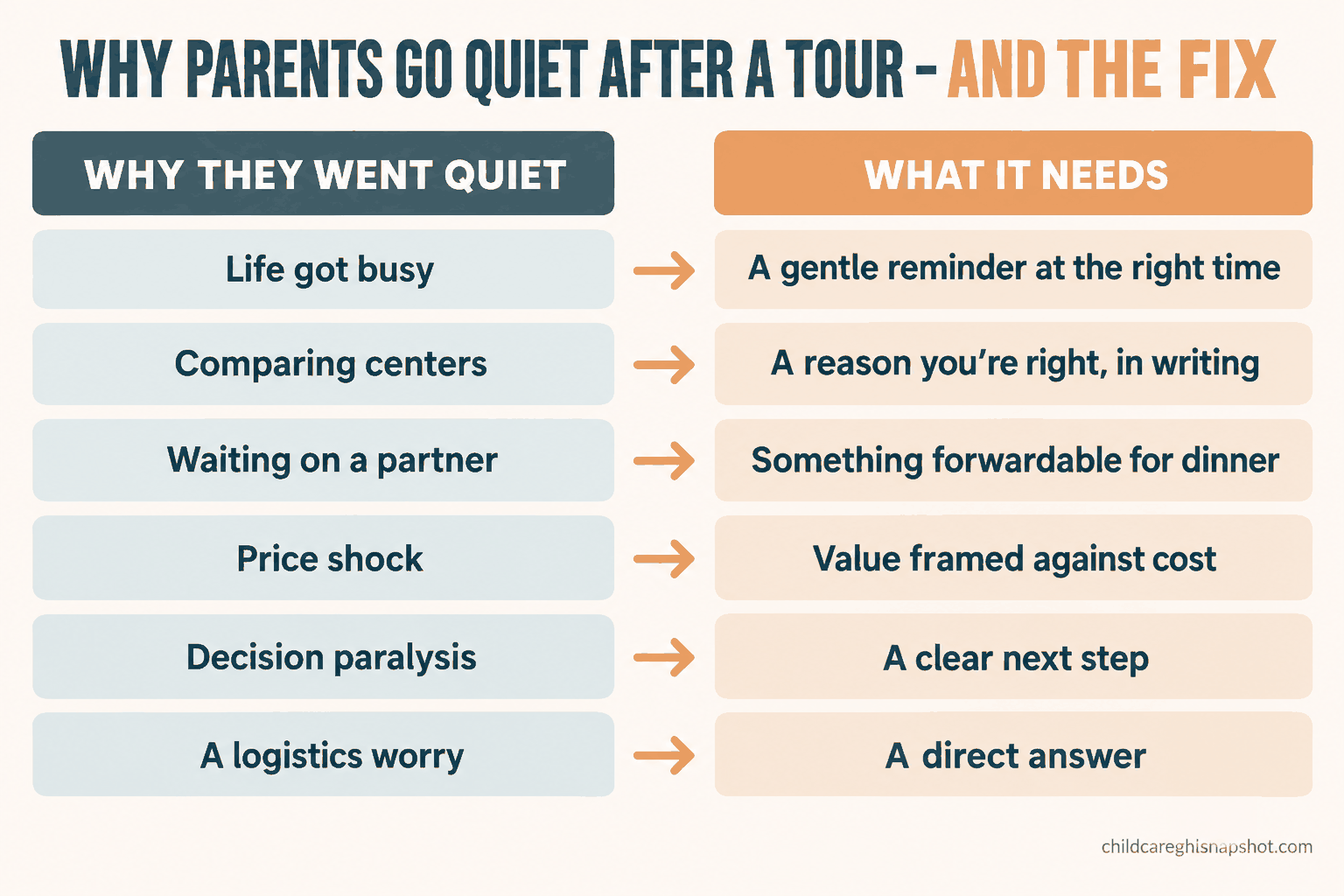
Not one of these is “your center is bad.” Five are solved by a message at the right moment, and the sixth, price, by talking about value instead of hoping they forget the number.
The post-tour follow-up system
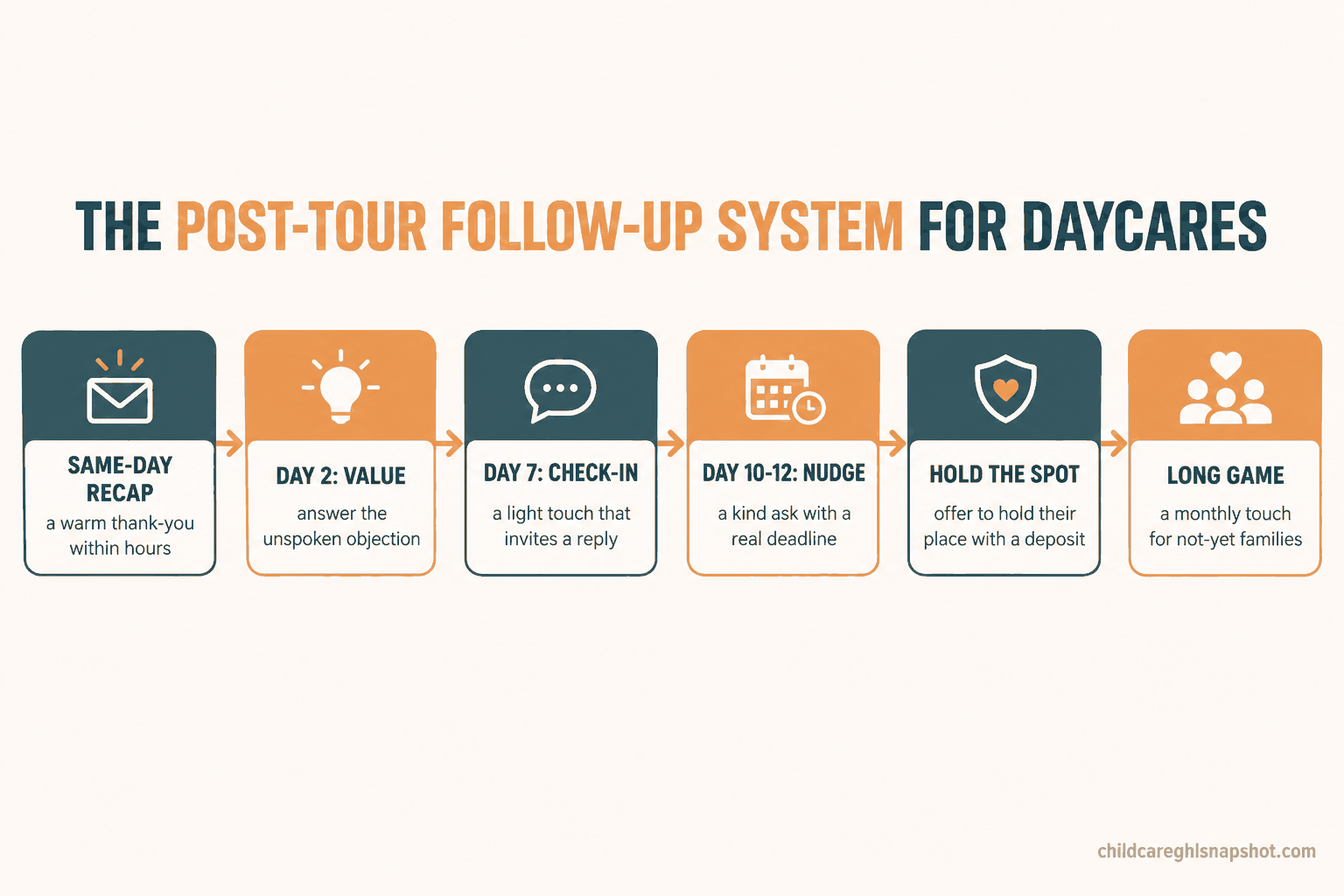
You are walking a family from “this feels right” to a paid deposit over two weeks, with a planned touch at each point where families stall.
- ✉️Same day
Recap
A warm thank-you with one clear next step.
- 🌟Day 2
Value + proof
Answer the real objection they did not say.
- 👋Day 7
Check-in
A light touch that invites a reply.
- ⏳Day 10-12
Decision nudge
A kind ask with a real deadline.
- 🎟️When full
Hold the spot
Offer to hold their place with a deposit.
- 🌱Ongoing
Long game
A monthly touch for 'not yet' families.
Write these six messages once, in your own voice, and the Hendersons get a follow-up on schedule, whether you remembered or not.
Stage 1: The same-day recap
This matters more than all the others, and most centers skip it. The warmth a parent feels right after a tour has a short shelf life. By day three it has faded into a vague good impression they can no longer act on.
Send a short, warm recap the same day, not a form letter. Name the child, mention one real thing from the tour, and give exactly one next step. Speed matters here too: Harvard Business Review, studying more than 2,200 companies, found that responding within an hour makes a lead about seven times more likely to qualify, and 60 times more likely than waiting a day.
How it breaks. The recap that never goes out because pickup ran late, or the generic “thanks for touring” with no child’s name. The fix is to make it automatic, triggered the moment you mark the tour complete.
Stage 2: The day-two value message
A day or two after the tour, send the message that answers the objection the family did not say out loud. You usually know what it is, because you watched them: the dad who went quiet at the tuition sheet, the mom who needed to talk to her husband. Speak to it before it hardens into the reason they never call back.
If the hesitation was cost, talk about value and options, not a discount: name what tuition includes that a cheaper option does not, and mention auto-pay if you offer it. If the parent has to convince a partner, give them something forwardable for dinner: a short note, a room photo, a link to your reviews. If it was a logistics worry, answer it plainly, because a half-answer keeps them stuck.
How it breaks. Sending another “just checking in,” which reads as you not listening. Or leading with a discount, which teaches parents to wait for a better one. Answer the real thing, once.
Stage 3: The one-week check-in
About a week out, send a light, genuinely human check-in. The goal is not to close, it is to reopen the conversation, because a family that replies is one you can help. Ask one simple question, and give them permission to tell you where they actually are, including “we went with somewhere closer.” A clear no is more useful than silence: it frees the seat and stops you chasing a ghost.
How it breaks. The check-in that is a sales pitch in disguise, which gets ignored. Or checking in every two days until the parent mutes you. One thoughtful touch at the week mark works.
Stage 4: The decision nudge with a deadline
Around day ten to twelve, a family that is still warm but drifting usually needs permission to decide. A big, emotional choice about a child floats indefinitely unless something gives it an edge. This message is that edge: a clear, kind ask with a real reason to act, such as the age group filling up or the start date approaching. Not a fake “act today,” but a true one.
How it breaks. Never asking, so the family drifts until they land somewhere that did. Or a manufactured urgency (“enroll by midnight”) that feels like a car lot. The nudge only works if the deadline is true.
Stage 5: The hold-your-spot offer
Sometimes a family is ready to say yes but scared to commit money. Stage 5 gives them a smaller step that still protects your seat. A refundable or first-month-credited deposit turns “we are leaning toward you” into a real hold, and separates the families who mean it from the ones who keep touring.
Frame the deposit as a favor to them: their child’s place is safe while they finish paperwork. Make it easy to pay from a phone, and check your state licensing and consumer rules before setting the amount. Once it is in, move them into your enrollment funnel so the yes becomes a confident first day.
How it breaks. No deposit, so a verbal yes evaporates when a closer center calls. Or collecting it and then going silent, which is how a committed family talks itself back out. A mobile deposit link and an immediate “here is what happens next” close the gap.
Stage 6: The long game for “not yet” families
Not every quiet family is a lost one. Plenty are a “not yet”: the baby is four months old and they want to start at six. These families are gold, and most centers drop them because the calendar says no today. Stage 6 keeps them warm until their start date arrives.
Once a month, send something useful and low-pressure: a photo from the room their child would be in, a quick “still saving a place for you.” Nothing that demands a reply, just a reminder that when their timing lands, you are the obvious call. This is the same discipline that turns a waitlist into enrolled families, pointed at families who toured and were not ready yet.
How it breaks. Dropping the family because they cannot start now, then wondering in three months why they enrolled down the street. Or pestering weekly until they go cold. Monthly and easy to ignore keeps you top of mind.
Run it three ways
The six stages are the same at every size. The effort and the failure points are not.
The home daycare (8 to 12 children). Each family is a huge share of your income, so one quiet family really hurts. You lose them at Stage 1, because you are teaching all day and the recap never gets sent. The highest-return move is one automated recap that fires the moment a tour ends, plus a day-ten nudge.
The single center (40 to 80 children). You tour enough families that the ones slipping through the two-week window add up to real empty seats, and the front desk and director each think the other is following up. Consolidate to one list everyone sees, and automate the sequence.
The multi-site group (100-plus children). A family often does not care which location they get into, but if a parent toured Location A and the follow-up lives only in that inbox, nobody offers them the seat that opened at Location B. Standardize the messages across sites and centralize who toured where.
The compliance part you cannot skip
Because most of this runs on text, a few rules bind you, and the full 2026 texting guide has the detail. Follow-up and marketing texts need prior express written consent, so put an unchecked opt-in checkbox on your forms, and never import an old list and blast it. Register your number for A2P 10DLC through The Campaign Registry, or US carriers quietly filter your texts into nowhere. Under the Telephone Consumer Protection Act, a non-consented blast carries statutory damages per message.
One rule specific to childcare: keep your marketing follow-up separate from any parent channel that touches attendance or health records, and never name or picture a specific child without consent on file. FERPA generally does not apply to a private licensed daycare, but your state licensing rules on child-record confidentiality and photo consent do. Put a clear “reply STOP” on every text.
The objections I hear from directors
“If they wanted us, they would call back. Chasing feels desperate.” It is wrong more often than right. A parent choosing care is overwhelmed and comparing options while holding down a job. A warm, well-timed follow-up reads as a center that pays attention, exactly the signal a nervous parent wants. The centers that look desperate are the ones that go silent, then send a panicked discount three weeks later.
“I do not have time to follow up with every family who tours.” You do not have to. Written once, these six messages send themselves, so your time goes to the tour and the first day. If that is another job you do not have, the enrollment automations run the sequence for you.
“I already pay for Brightwheel or Procare. Isn’t this handled?” Those tools run your center after a family enrolls: attendance, daily reports, billing. They are not built to chase a prospective family after a tour. That is a different job, and I mapped where the lines fall in the childcare software pricing teardown.
“Won’t automated messages feel cold?” Only if you write them cold. The copy here names the child and sounds like a person, because you wrote it in your voice. Automation controls the timing, not the warmth. A parent cannot tell your recap came from a workflow, only that you followed up faster and kinder.
Your questions, answered
Why do parents stop responding after a daycare tour?
Usually because life got busy, they are comparing centers, waiting on a partner, or the tuition gave them pause. It is rarely a rejection, and almost all of it is solved by a warm, well-timed follow-up rather than silence.
How soon should I follow up after a daycare tour?
The same day, ideally within a few hours, while the good feeling is fresh. Research on more than 2,200 companies found responding within an hour makes a lead far more likely to convert. A short recap that names the child and gives one next step is the highest-return follow-up you can send.
How many times should I follow up before giving up?
About four to six touches over two weeks: a same-day recap, a value message around day two, a check-in near day seven, and a decision nudge around day ten to twelve, plus a monthly touch for 'not yet' families. Spread out and useful, it feels attentive, not pushy.
What should I say in a follow-up text to a parent who toured?
Name the child, recall one real moment from the tour, and give exactly one next step, such as an enrollment or deposit link. Address the specific hesitation you noticed, whether cost, timing, or a partner who was not there, and include a clear way to opt out.
Can I legally text parents who toured my daycare?
Yes, with consent. Follow-up texts require prior express written consent, so use an unchecked opt-in checkbox, register your number for A2P 10DLC, and include a STOP option. Keep marketing separate from any channel that touches a child's records. Our 2026 texting guide has the full rules.
So, back to the Hendersons. With this system, the mom got a warm recap Monday afternoon that named her baby and the room she teared up in, then a Wednesday note about what tuition covers. Her week fell apart before she could reply, so your Sunday check-in landed at the right moment and she wrote back: “Yes, we want the spot, how do we hold it?” She pays the deposit that night, and the seat fills by the following week. It was never a no, just a family who needed you to stay in the conversation. If you want the instant recaps, timed nudges, and deposit collection built to run this way, that is what a done-for-you enrollment system is for.