

A mom signs the enrollment paperwork on a Friday. She is thrilled, you are relieved, and the infant room fills a seat you have stared at for a month. Then Monday comes, she hands you a crying eight-month-old at 7:30am, and hears nothing all day. No text, no photo, no “she settled after twenty minutes.” By Wednesday she is quietly wondering if she picked the wrong place. By month’s end she has toured somewhere else “just to compare.” You did the hardest part, you won her, and now you are losing her in the first thirty days because nobody built the handoff between enrolled and settled.
That handoff is onboarding, and most centers do not have one. You have a tour system, maybe a waitlist, then a cliff. This post is the sequence that fills the cliff: the exact messages, calls, and checkpoints for a family’s first thirty days, built to run whether or not you remember to. Get it right and a nervous new parent becomes a settled, paying, referring family. Get it wrong and you pay to fill the same seat twice.
What this post covers
- What an early goodbye actually costs you
- The first 30 days, stage by stage
- Stage 1: The same-day welcome
- Stage 2: Paperwork and immunizations, without the chase
- Stage 3: Day one, done on purpose
- Stage 4: The week-one check-in
- Stage 5: The two-week settling-in call
- Stage 6: The 30-day review and referral ask
- Steal these: the onboarding messages
- Run it three ways
- The compliance part you cannot skip
- Objections I hear from directors
- Your questions, answered
What an early goodbye actually costs you
I came up through the front office of a three-site preschool group, and the families who left early almost never told us why. They went quiet, missed a few days, then the withdrawal email landed. We lost them over things that cost nothing to fix: a parent out of the loop, a form nobody chased, a first week with no reassurance.
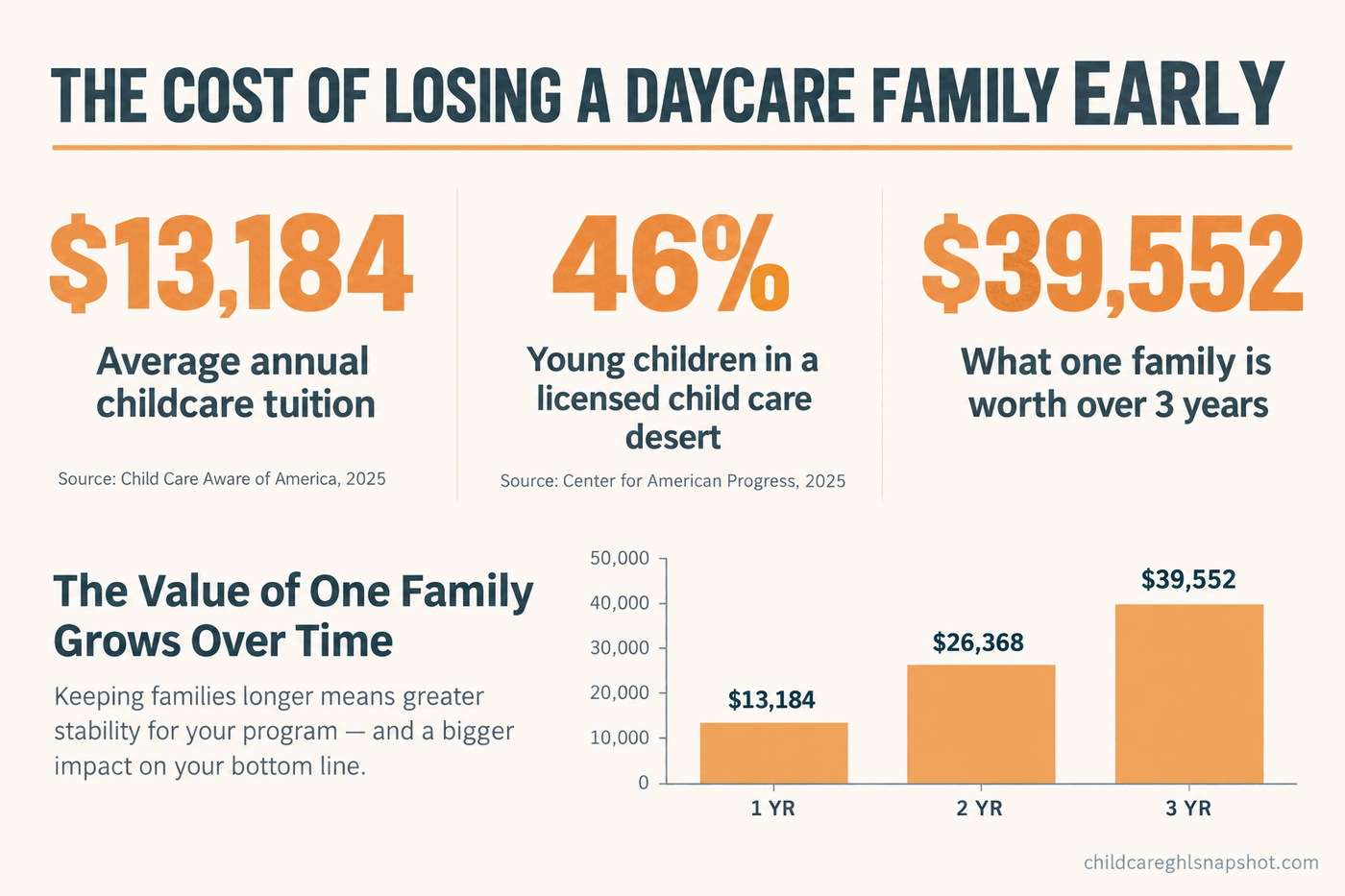
The national average price of child care in 2025 was $13,184 a year, per Child Care Aware of America, roughly $1,099 a month. A family that enrolls an infant and stays three years is worth close to $40,000 before siblings and referrals. A family that leaves at week six is that whole relationship gone, plus the cost of refilling the seat in a market where seats are not the problem: 46% of children under 6 still lived in a licensed child care desert in 2025, down from 51% in 2018, per the Center for American Progress. Demand is there. Keeping the family you just signed is the harder skill.
And the early window is where it is won or lost. A study in the Journal of Consumer Marketing found parent satisfaction predicts continued enrollment most strongly when the child is very young, birth to about one year. That gut read of “do I trust these people” forms in the first few weeks from small signals: a photo texted, a child’s name remembered, paperwork handled like professionals. Onboarding stacks those signals on purpose instead of hoping they happen.
Tuition collected from one family at the 2025 national average of $13,184 a year (Child Care Aware of America). The gap between the first bar and the third is what a weak first month costs you.
The first 30 days, stage by stage
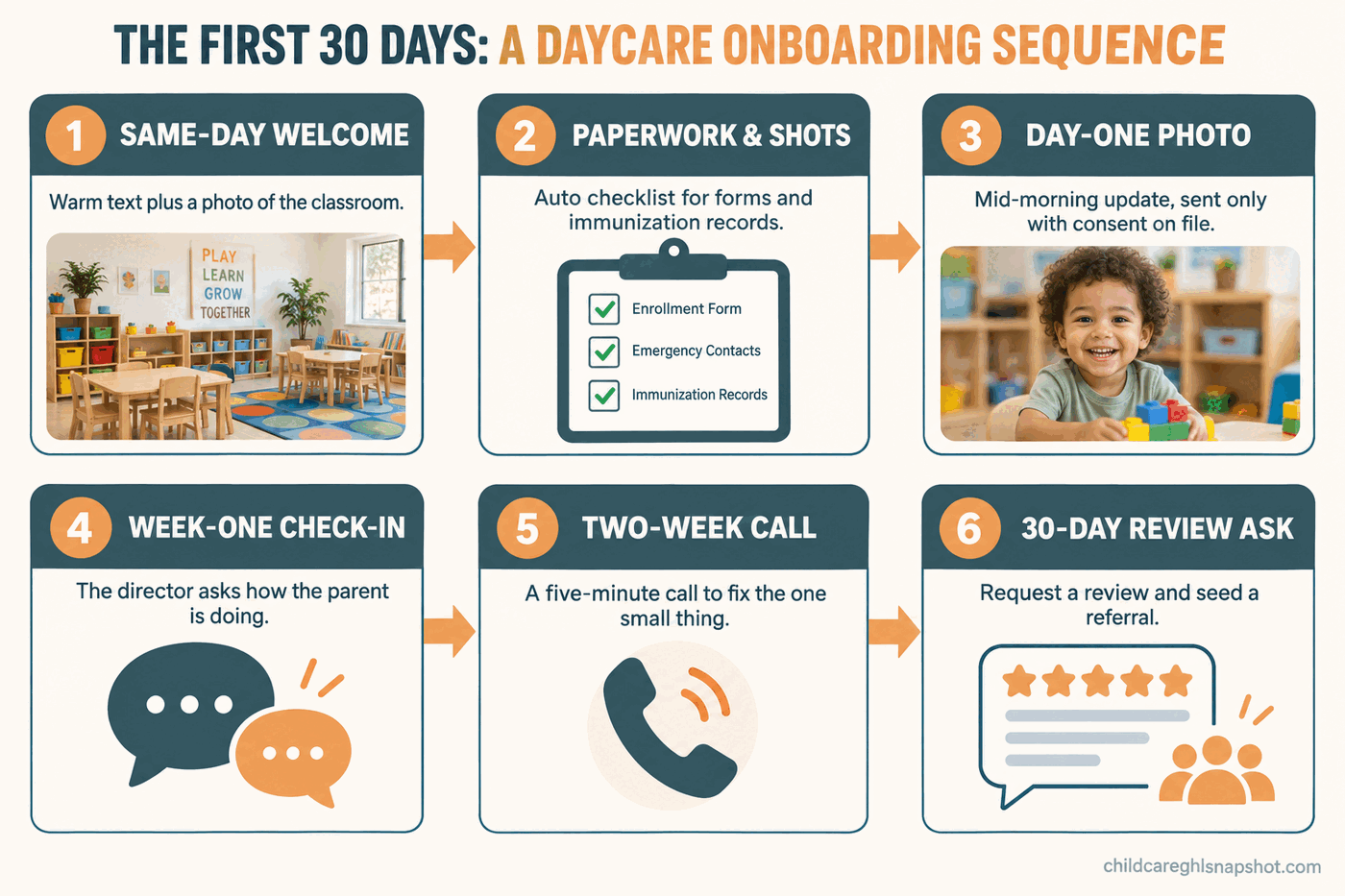
The sequence has six stages, each tied to a point in time you already know: the enrollment date and the start date. You set the triggers once; the system does the remembering.
Stage 1: The same-day welcome
The moment a family enrolls, a warm welcome goes out the same day, while the good feeling is fresh. Not a contract, not a portal invite in legalese. A short, human message: we are so glad [child] is joining us, here is the first day and what to bring, here is your child’s lead teacher, and here is how to reach us. Include a photo of the actual classroom, because a parent who can picture the room sleeps better before day one. Then set the expectation: “You’ll get a photo and a note every afternoon, and a check-in from me after week one.” Now she knows silence is not the plan.
How this breaks: A welcome that is all paperwork and no warmth turns a happy decision into a chore, so lead with the human message. And a welcome that waits on someone’s memory never fires, so tie it to the enrollment date.
Stage 2: Paperwork and immunizations, without the chase
Here is where good intentions die. Enrollment forms, emergency contacts, and immunization records are a licensing requirement, and chasing them by hand is the job everyone hates. Nearly every state requires immunization records on file to attend licensed care, often before the first day. Washington, for example, requires licensed child cares to collect immunization documentation and keep it on site, and other states run similar rules with their own deadlines. A missing shot record is a finding waiting to happen at your next inspection.
So automate the chase, kindly. The day after enrollment, a checklist goes out: what we need, the upload link, the deadline. A gentle reminder follows for anything missing, and a final nudge before the start date. The parent is helped by a system, not nagged by a person.
How this breaks: A single form asking for everything at once gets abandoned on a phone in a parking lot, so split it into “before day one” (legal must-haves) and “first week” (the rest). Without a deadline and reminder, the record sits incomplete until an inspector asks. It is the same intake discipline behind a reliable first-contact system.
Stage 3: Day one, done on purpose
The first drop-off is the scariest moment for a new parent and the moment you can win or lose a year of tuition. The child cries, the parent walks to the car feeling like a villain, then sits at her desk imagining the worst. Interrupt that story. Mid-morning, send a photo of the child playing or settled with the teacher and one honest line in your own voice (exact wording below). That one text replaces a parent’s worst imagined story.
Day one is also the consent checkpoint. Before you send any photo of a specific child, the photo-consent form must be signed and on file, and in most states that consent cannot be a condition of enrollment. Build the sequence so the day-one photo only goes to consented families, and everyone else gets a words-only update until the form is in.
How this breaks: A silent first day leaves a parent eight hours to fill with worry, and that worry becomes the story she tells about your center. The other failure is sending a photo before consent is on file, turning a lovely gesture into a licensing problem. Make consent a gate the automation checks, not a thing a teacher remembers under pressure.
Stage 4: The week-one check-in
By Friday of week one, the family has survived the scariest part, so reinforce the decision before the weekend, when doubts grow. This one is personal: a short message from the director, not the app, asking how the parent is doing, because the parent decides whether to stay.
That one question surfaces the small complaint she would never call about but will happily text, so you can fix it before it becomes a reason to leave. Families who leave rarely complain first, they go quiet, so you have to ask.
How this breaks: Sending it from a no-reply number or a generic app blast. If the reply goes nowhere, you have taught her that reaching out is pointless.
Stage 5: The two-week settling-in call
Around two weeks in, the novelty has worn off and the real routine has set in. This is the churn moment nobody schedules for, so schedule for it: a five-minute call from the director or lead teacher. A call lands differently than a text here, and what a parent says out loud at two weeks decides month three.
Have one question ready: “Is there anything that would make this easier for you?” Then listen. Most of what you hear is small and fixable: a bottle preference nobody wrote down, a tight pickup, a nap worry. Fixing one of those in week two is the cheapest retention you will ever buy.
How this breaks: Skipping the call because everything “seems fine.” Fine is exactly when families drift, because fine is not committed. The call is for the quiet middle who leave if nobody gives them a reason to stay. And the moment it feels like an upsell, you have spent your goodwill.
Stage 6: The 30-day review and referral ask
At thirty days, a happy family is at peak warmth and willingness to say so publicly, and most centers never ask. Time the review request to a specific high point, not a random Tuesday: right after a great daily report, or after a two-week call that went well. One ask at the right moment earns more reviews than a monthly blast.
The referral seed rides along: “If you know another family looking, we’d love to meet them.” A parent one month in and happy is your best marketing, because other parents trust a parent. For timing both asks without feeling transactional, see my playbook on turning happy parents into reviews and referrals.
How this breaks: Asking too early, or asking everyone regardless of how their month went. A review ask sent to a family that had a rocky month invites a one-star review you created yourself. Gate the ask on a positive signal, and route anyone who replies with a problem to a human to fix first, not to a review link.
Steal these: the onboarding messages
The sequence is only as good as the words in it. Copy and adapt these in your own voice, and keep them short, because a long text reads like marketing and a new parent is already overwhelmed.
The same-day welcome:
Hi [first name]! We’re so happy [child] is joining the Sunrise family. Her first day is [date], her lead teacher is Miss Dana, and here’s a peek at her room: [photo]. Bring a change of clothes, a comfort item, and labeled bottles. You’ll get a photo and a note every afternoon, and I’ll check in with you myself after week one. Can’t wait!
The paperwork checklist (day after enrollment):
Hi [first name], one quick thing so [child]’s first day goes smoothly. We need these on file before [start date]: immunization record, signed enrollment form, and two emergency contacts. Upload them here in two minutes: [link].
The day-one photo (mid-morning, consent on file):
Good morning! [Child] cried for about ten minutes at drop-off, then found the water table and hasn’t looked back. Having a great first morning. [photo] We’ve got her. Enjoy your day.
The week-one check-in (Friday, from the director):
Hi [first name], it’s Priscilla, the director. I wanted to check in myself. [Child] had a lovely first week and is starting to recognize her teachers. More important, how are YOU doing with the transition? Reply here anytime, I read these.
The 30-day review ask (after a high point):
Hi [first name], hard to believe it’s already been a month, and [child] is thriving. If you have two minutes, a quick Google review would mean so much and helps other local families find us: [link]. No pressure at all, and thank you for trusting us with her.
Wired to fire on the enrollment and start dates, these run without anyone watching the calendar. For the daily afternoon updates between them, see my guide to daily reports parents actually read.
Run it three ways
The same six stages scale up and down. What changes is who runs each piece and where the risk sits.
Solo operator, one site, 30 to 50 children. You are the director, the closer, and sometimes the floater, so automation is the only way the welcome and paperwork chase happen at all. Let the system own Stages 1, 2, and 6, and keep the two human touches for yourself. At your size a parent expects to hear from you personally, and that contact is your edge over a big chain.
Mid-size, one or two sites, 60 to 100 children. You likely have an office lead who can own onboarding. The system’s job is to make sure no family slips through when that person is out sick or buried. Automate the timed messages, assign the human touches to a named person, and watch the handoff: the common leak here is a family who enrolled while the office lead was away and got no welcome at all.
Multi-site, three or more locations. Your risk is inconsistency: Site A runs a warm onboarding, Site C runs none, and you cannot see it until a withdrawal pattern appears. Standardize the sequence so every family gets the same first thirty days, route the human touches to each site’s director, and centralize reporting so you can see which site completes the check-ins. The math on what an empty classroom costs makes the case for closing that gap fast.
The compliance part you cannot skip
Onboarding runs on messages and photos of children, so run it legally. Three rules matter.
First, photos and child records. Many directors assume FERPA governs this; for a private licensed daycare it generally does not, so do not rely on it. What binds you is your state’s licensing rules on child-record confidentiality and photo consent. Never send, post, or use a photo of a specific child without written consent on file, that consent cannot be a condition of enrollment, and anything touching a child’s health or attendance records stays in the parent-only channel and never feeds a marketing list.
Second, the texts. The TCPA governs automated messaging, with statutory damages of $500 per violating message and up to $1,500 for a willful violation. Onboarding texts to a parent who just enrolled are operational and transactional, the low-risk category, so keep them about scheduling, paperwork, and their own child, and collect consent at enrollment.
Third, A2P 10DLC. To text from a regular 10-digit business number in the US, you must register through your provider and The Campaign Registry, or carriers quietly block your messages and your welcome sequence delivers nothing. The full breakdown is in the 2026 guide to texting daycare parents legally.
Objections I hear from directors
“Won’t automated onboarding feel cold?” It feels far warmer than silence. The automation handles timing and delivery, not the warmth. You write the words once in your own voice, and the system makes sure they arrive even when you are covering a classroom.
“I already pay for Brightwheel or Procare.” Those tools are good at running the center once a family is enrolled: check-in, billing, daily reports. They are not built to run a timed thirty-day welcome sequence to a brand-new family, and most charge per child. This layer sits on top and feeds the tool you already use. If you are weighing the real costs, I broke down what childcare software actually costs in 2026.
“Do I need to be technical?” No. You set the messages and two triggers once, the enrollment date and the start date, and then it runs. Your only ongoing job is the two human touches and answering replies.
“I only enroll a few families a month.” Then each one matters more, not less. A sequence that saves even one family a year has paid for itself several times over at $13,184 a head.
Your questions, answered
What is new-family onboarding for a daycare?
The planned sequence of messages, checkpoints, and calls that carries a family through their first thirty days, from signing paperwork to feeling settled: the same-day welcome, collecting legal paperwork and immunization records, the first drop-off, a week-one check-in, a two-week call, and a 30-day review and referral ask. The goal is to stop families leaving in the first month, when they are most likely to.
Why do families leave a daycare in the first few weeks?
Usually not the care itself, but how they feel about it. Parents who hear nothing fill the silence with worry, and small unaddressed frictions (a tight pickup, a missed bottle preference) become reasons to leave. A Journal of Consumer Marketing study found parent satisfaction predicts staying enrolled most strongly when the child is very young, so the early weeks carry outsized weight.
Can I automate onboarding without it feeling impersonal?
Yes. Automate the timing and delivery of the welcome, the paperwork reminders, and the review ask, and keep two touches human: the week-one check-in and the two-week call. You write every message in your own voice once, so what the parent receives is warm, it just arrives reliably instead of depending on anyone remembering.
Do I need photo consent before texting a parent a picture of their child?
Yes. For a specific child you need written photo consent on file before you send, post, or use any image, and in most states that consent cannot be a condition of enrollment. Build the day-one photo so it only goes to consented families, and send words-only updates to everyone else until the form is in.
Is it legal to send automated onboarding texts to parents?
Done right, yes. Texts to a parent who just enrolled about scheduling, paperwork, and their own child are operational and carry low risk under the TCPA, if you collect clear consent at enrollment. You must also register your number for A2P 10DLC or carriers block the messages, and keep health and attendance details in the parent-only channel.
So go back to that Friday enrollment. Same mom, same crying eight-month-old on Monday. Only this time she got a warm welcome Friday with a photo of the room, uploaded the paperwork over the weekend, and at 10:15 Monday her phone buzzed with a picture of her daughter at the water table: “We’ve got her.” At the end of week one, the director asked how SHE was holding up. At two weeks, a five-minute call fixed the one thing bugging her. At thirty days, she left a five-star review and mentioned a coworker due in spring. You did not just fill a seat. You kept a family, and families keep you full.