

You are on your third demo call this week. The rep is friendly, the slides are nice, the parent app looks lovely. Forty minutes in you ask the only question you came to ask, which is “so what does it cost,” and the answer is some version of “let me build you a custom quote.” You hang up knowing less about the price than when you picked up. Meanwhile there are two teachers out sick, a toddler-room ratio to fix by 9am, and a family on the waitlist you still have not called back.
Here is the short version, so you do not have to sit through the rest to get it. Most childcare software in 2026 does not publish a price, and the ones that charge per child get more expensive every time you enroll a family, which is the exact opposite of what you want. One vendor, Playground, publishes a flat $2.00 per student per month with no contract. Everyone else makes you book a call. This post lays out what each one really costs, where the hidden fees hide, and how the math changes for a home daycare, a single center, and a multi-site group.
What this post covers
- Why childcare software hides its prices
- What each tool actually costs in 2026
- The hidden costs nobody quotes you
- Three real budgets: solo, mid-size, and multi-site
- Steal this: the demo-call script that forces a real number
- Where enrollment automation fits (and where it does not)
- A quick word on compliance before you automate texts
- Your questions, answered
Why childcare software hides its prices
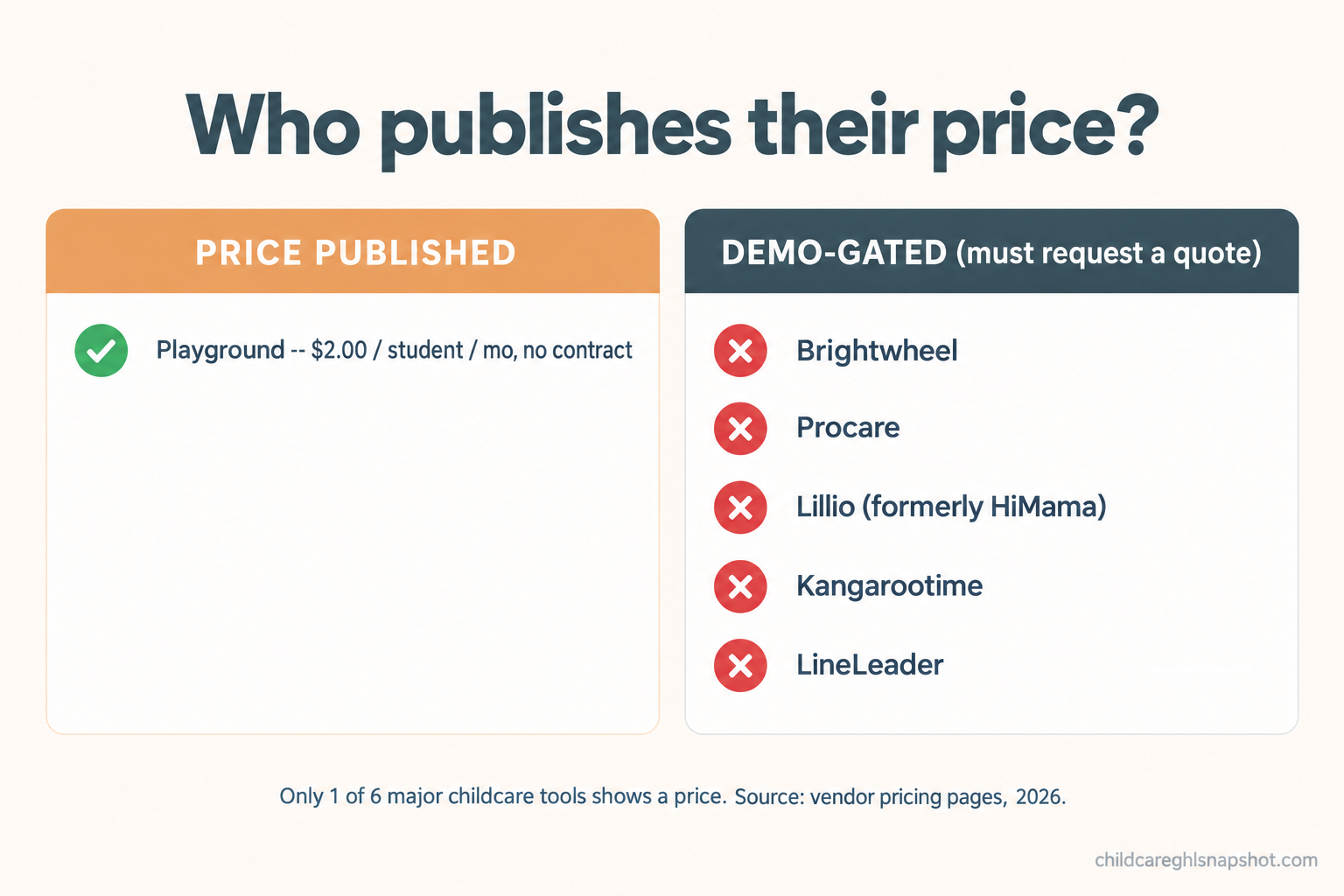
Walk through the pricing pages of the big childcare platforms and you will notice the same thing over and over: no price. As of late 2026, Brightwheel’s pricing page asks you to speak to a specialist. Procare routes you to a request-pricing form. Kangarootime, Lillio and LineLeader all do the same. You cannot comparison-shop a number you are not allowed to see.
There is a reason for this, and it is not a conspiracy. Demo-gated pricing lets a sales team size you up and quote to what they think you will pay rather than a published rate. It also buries the comparison: if you cannot line up four prices side by side, you cannot tell that one vendor is charging you double for the same attendance tracker.
The practical cost to you is time. Every gated quote is a 30-to-45-minute call, often two, before you know whether a tool is even in your range. For a director who is already covering a classroom, that is the most expensive part of the purchase.
What each tool actually costs in 2026
Here is the honest state of pricing, vendor by vendor. Where a number comes from the vendor’s own page, I say so. Where it comes from review sites and operator reports instead, I label it reported, because the vendor will not confirm it. Do not treat a reported figure as a quote. Treat it as a starting point for the call.
| Tool | Price published? | Model | What operators report paying | Watch out for |
|---|---|---|---|---|
| Playground | Yes | Flat per student | $2.00 / student / mo, no contract (published) | Honestly, very little. This is the transparent one. |
| Brightwheel | No, demo-gated | Base + per child | Reported ~$15-30/mo base plus ~$2-3 per child/mo | Payment processing (reported ~2.9% + $0.30 per transaction) |
| Procare | No, demo-gated | Modular / tiered | Reported ~$25/mo in-home, ~$60-85/mo for a licensed center | Payments add-on (reported from ~$25/mo), kiosk hardware, implementation |
| Lillio (formerly HiMama) | No, demo-gated | Per child | Reported ~$400-500/mo at 100+ children | Per-child model scales hard as you grow |
| Kangarootime | No, demo-gated | Custom quote | No reliable public figure exists | Fully bespoke pricing; you only learn it on the call |
| LineLeader (by ChildcareCRM) | No, demo-gated | Custom quote (enrollment CRM) | No reliable public figure exists | Priced as enterprise CRM, not a small-center tool |
A few things worth saying in plain words.
Brightwheel is the default most directors land on, and it is a capable all-in-one. But it charges a base fee plus a per-child fee, so the bill grows with your roster, and its integrated billing carries a card-processing cut on every tuition payment. The monthly number operators report ranges widely, from under $100 for a small room to $150-400 and up for a full center, depending on plan and headcount.
Procare is the old guard, and it prices in modules. Procare’s own materials say there are no setup fees and no contracts, which is a genuine point in its favor. The dollar figures, though, come from third parties like GetApp: roughly $25 a month for an in-home program and more like $60-85 for a licensed center that wants the cloud plan plus the parent app. Add the payments module and a check-in kiosk and the real monthly number climbs.
Lillio is the product formerly known as HiMama. It rebranded in 2023, and every listing now reads “Lillio (formerly HiMama).” It is strong on daily reports and early-learning documentation, and it prices per child. Operators at larger centers report $400-500 a month or more. I could not verify the often-repeated “$8-12 per child” figure on any reliable source, so I am not going to quote it as fact.
Kangarootime and LineLeader are both quote-only, and no trustworthy public number exists for either. LineLeader in particular is built as an enrollment CRM for bigger groups and chains, and it is priced accordingly. If you run one or two sites and someone points you at LineLeader, ask for the number early, because it is usually aimed at a different size of operation than yours.
The hidden costs nobody quotes you
The monthly sticker price is the part they will eventually tell you. The total cost of ownership is the part you have to dig for. This is where pricing models break, and it is the single most useful thing to understand before you sign anything.
Per-child pricing breaks when you succeed. This is the big one. A per-child model, like Brightwheel’s and Lillio’s, means your software bill rises every single time you enroll a family. You did the hard work of filling the seat, and your vendor takes a cut of it forever. Fill twenty more spots and your “$150 a month” tool is suddenly $250. Flat pricing, like Playground’s $2 across the board, does not do this. It is the difference between a tool that roots for your growth and one that taxes it.
Payment processing is a second, invisible subscription. Any tool that runs tuition through its own billing takes a card-processing fee, commonly reported around 2.9% plus 30 cents a transaction. On a center collecting $40,000 a month in tuition, roughly 2.9% is about $1,160 every month, far more than the software subscription itself. Always ask what the processing rate is and whether ACH or bank transfer is cheaper than card.
Implementation and migration fees are real. For modular or enterprise tools, getting set up is not free. Third-party analysis of Procare, for example, puts implementation and migration anywhere from about $1,000 to $5,000 for a smaller operation. Ask whether onboarding, data import, and staff training are included or billed separately.
Contracts and your own data. Ask two blunt questions. Is there a minimum term, and can I leave monthly? And if I leave, can I export my child records, billing history, and parent contacts in a usable file, for free? A tool that makes your own data hard to take with you has quietly locked you in, even if that never shows up on an invoice.
Three real budgets: solo, mid-size, and multi-site
The right answer genuinely depends on your size, because the pricing models behave completely differently as you grow. Here is the same decision run three ways. The per-child figures below use the rates operators report, since the vendors will not publish them, so read them as illustrative, not as quotes.
The solo operator (home daycare, about 12 children)
At twelve kids, per-child pricing barely stings yet, so the monthly numbers are all close. Playground runs about $24 a month. A reported Brightwheel setup lands near $55 with the base fee. Procare’s in-home tier sits around $25. At this size, pick on features and simplicity, not price, because the gap is a few dollars. What actually matters for a home daycare is not losing an inquiry while you are hands-deep in finger paint, and no management app solves that on its own.
The mid-size center (about 60 children)
This is where the models separate. Flat pricing stays cheap and per-child pricing starts to bite.
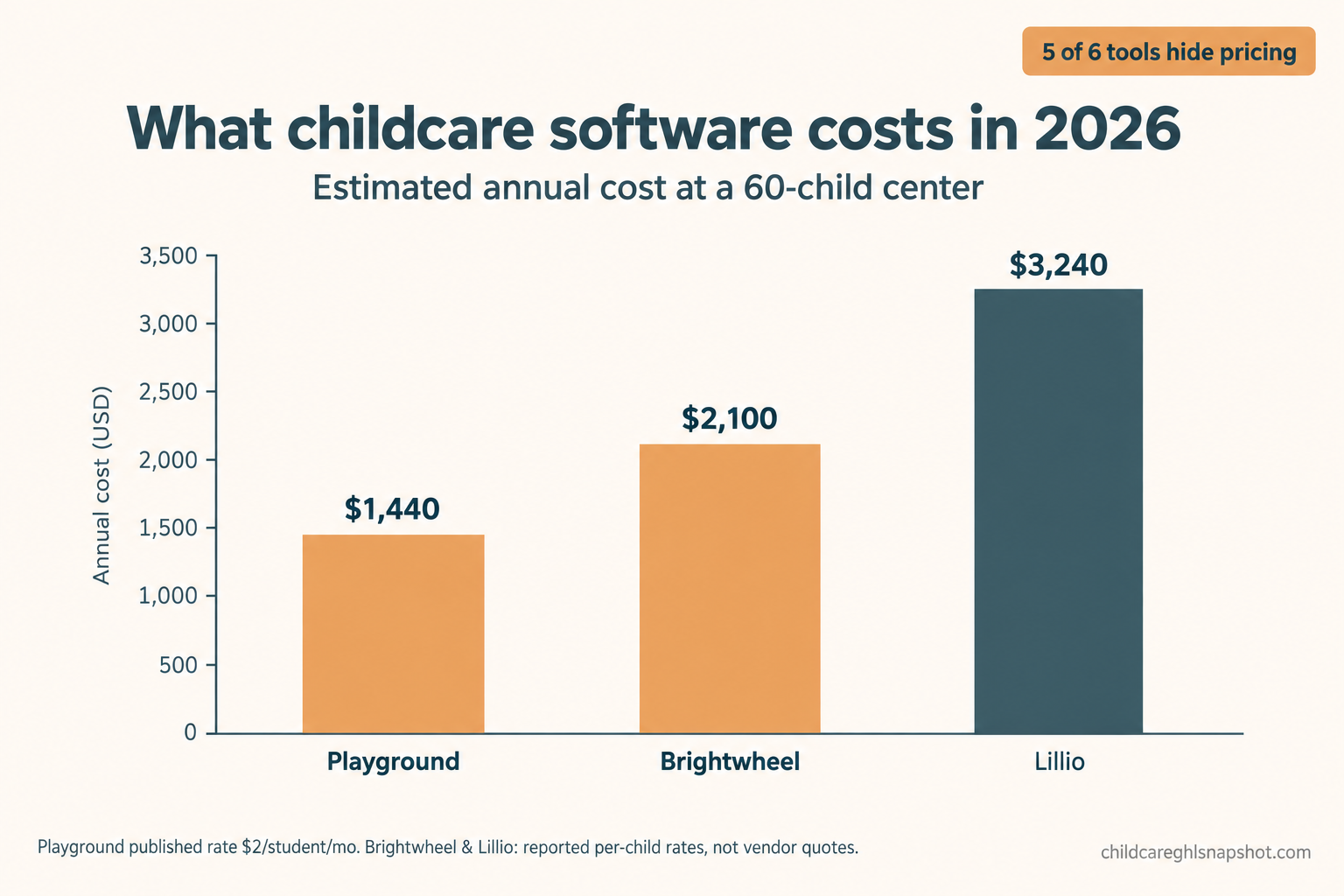
Estimated annual software cost at a 60-child center. Playground uses its published $2.00/student/month flat rate. Brightwheel and Lillio use the per-child rates operators report on third-party sites (Brightwheel base plus ~$2.50/child; Lillio ~$4.50/child), not vendor quotes, and exclude payment-processing fees. Sources: SaaSworthy, Neztio, Bloomily.
At sixty children, the flat-rate tool is roughly $1,440 a year and the per-child tools are two to three times that, before you count the processing cut on tuition. That spread is a full-time aide’s worth of supply budget. This is the size where it pays to run the math on your actual roster rather than trust a monthly number that sounded fine on the call.
The multi-site group (about 150 children across locations)
At this scale, two things happen. Per-child pricing becomes your largest software line by far, and you start getting pitched enterprise CRMs like LineLeader. A reported per-child tool at 150 kids can run $5,000-8,000 a year or more, before implementation. Flat pricing stays proportional and predictable. You also feel the enrollment gap most sharply here: a multi-site group lives or dies on keeping every location’s waitlist moving, a different system from the one tracking nap times.
Steal this: the demo-call script that forces a real number
Since five of the six vendors will not publish a price, you have to extract it. Copy these questions into your notes and ask them in this order on every demo call. They are designed to get a real number fast and surface the hidden costs before you are emotionally sold on the parent app.
- “Is your pricing per child or a flat rate? If per child, what is the exact per-child amount, and is there a base fee on top of it?”
- “For a center my size, [X] children, what is the all-in monthly total, including the parent app and billing?”
- “What is the card-processing fee on tuition payments, and do you charge less for ACH or bank transfer?”
- “Is there a setup, onboarding, migration, or training fee? What is it in dollars?”
- “Is there a contract or minimum term, or can I cancel month to month?”
- “If I leave, can I export all my child records, billing history, and parent contacts myself, in a standard file, at no charge?”
- “Everything you just quoted, can you put it in writing in an email today?”
That last one does most of the work. A number that a rep will put in an email is a real number. A number they will only say out loud is a starting position.
Where enrollment automation fits (and where it does not)
Now the honest part, because you came here for a straight answer on cost. Everything above, Brightwheel, Procare, Lillio, Playground, is childcare management software. It runs attendance, daily reports, billing, and parent messaging for families who are already enrolled. That is real work and you need a tool for it.
It is not the same job as turning an inquiry into an enrolled family. The reason matters, because 46% of young children live in a licensed child care desert according to the Center for American Progress, which means in most markets the demand is there and the bottleneck is follow-up, not interest. The family that fills out your website form at 9pm, the tour that no-shows, the waitlist parent who went quiet in July: none of those is a nap-tracking problem. That is a speed-to-lead and follow-up problem, and a management app does not touch it.
This is the gap the Childcare Snapshot is built for. It is a done-for-you GoHighLevel automation system that handles the enrollment side: instant replies to new inquiries, tour confirmations and reminders that cut no-shows, waitlist nurture, review requests, and tuition reminders that stay warm. It is a one-time $997 setup on top of a GoHighLevel subscription, not a per-child bill, and it sits alongside whatever management app you use rather than replacing it.
A quick word on compliance before you automate texts
One thing no pricing page mentions but every center needs to get right: the rules on automated messaging. If you are going to text parents, whether through a management app or an enrollment system, two federal rules apply. The TCPA governs consent for automated texts, and A2P 10DLC is the carrier registration that business texting now requires in the United States. In plain terms, you need a clear opt-in before you text a family, and you need your number registered, or your messages start getting filtered out.
On child records, clear up one myth. FERPA, the school-records law, generally does not apply to private licensed daycares, so do not let a vendor scare you with it. Your real obligations come from your state’s licensing rules on child-record confidentiality and on photo and video consent, which you cannot make a condition of enrollment. The line to hold: never name or show a specific child in marketing without consent on file, and keep any automation touching attendance or health data in the parent-only channel, never feeding your marketing list.
Your questions, answered
How much does childcare software cost per month in 2026?
For a typical center, plan on about $50 to $400-plus a month, depending on the tool, your headcount, and add-ons. Playground sits at the low, transparent end at $2.00 per student per month. Per-child tools like Brightwheel and Lillio run higher and rise as you enroll more families, and none of that counts payment-processing fees on tuition, often the largest line.
Why won't Brightwheel or Procare show prices online?
Because demo-gating lets a sales team quote to your perceived budget and keeps you from comparison-shopping. It is a sales choice, not a technical limitation. The fix is to ask for an all-in number in writing on the first call.
Is per-child or flat-rate pricing cheaper?
For a small program they are close. As you grow, flat pricing wins clearly, because a per-child fee increases every time you fill a seat. At 60-plus children the difference can be a couple of thousand dollars a year.
What hidden costs should I ask about before I sign?
Four things: the card-processing rate on tuition, any setup or migration fee, whether there is a contract or minimum term, and whether you can export your own data for free if you leave. Get all four in an email before you commit.
Does cheaper childcare software mean worse software?
No. Playground is both the most transparent and among the best-reviewed tools in the category, at a flat $2. Price and quality are not the same axis here. Demo-gated and expensive does not mean better; it often just means the pricing is hidden.
Can I switch childcare software without losing my data?
Usually yes, but price the move. Ask the new vendor for a data-import service and the old one for a full export. Budget for a migration fee, a few weeks of paying for both tools at once, and staff hours to verify records. It is a one-time project cost, not a reason to stay stuck.
What does the Childcare Snapshot cost, and is it a Brightwheel replacement?
It is a one-time $997 setup on top of a GoHighLevel subscription, with no per-child fee. It is not a management app, so it does not replace Brightwheel or Playground for attendance and daily reports. It handles the enrollment and follow-up side (inquiries, tours, waitlist, reviews, and billing reminders) and runs alongside your management tool. You can get it installed in 24 hours.
So, back to that third demo call. Next time a rep dodges the price, you do not have to sit through the rest of the slides. Ask the seven questions, get the all-in number in writing, divide it by your enrollment, and compare it to two dollars a head. A tool that will not give you a straight answer on cost is telling you how the rest of the relationship will go. This whole sector runs on thin margins, as the Bipartisan Policy Center has documented, and you have every right to know what you are paying before you pay it.