

It is 9:20 on a Tuesday morning. You are in the two-year-old room covering a ratio because a teacher called out, your hands are full, and your cell buzzes. A mom found you on Facebook last night, filled out the little form, and now she is calling. You cannot answer, you are holding a child, and the call rings out. By lunch you have forgotten it happened. She does not forget. She called three centers this morning, and the one across town called her back by 9:45 and booked a Thursday tour. You never hear from her again, and you never find out why.
That is not a marketing problem. It is a timing problem, and it is the most expensive one in your building. The center that answers first almost always wins the tour, and the tour is where enrollment happens. The good news: answering first is a system you build once, and it runs whether you are on the floor or asleep.
What this post covers
- The parent who enrolls is the one who got called back
- The first-response system, end to end
- Stage 1: Catch every inquiry in one place
- Stage 2: Reply in five minutes, even at nap time
- Stage 3: The two questions that book a tour
- Stage 4: Confirm the tour so it actually happens
- Stage 5: Catch the families who go quiet
- Stage 6: Hand the hot ones to a human fast
- Steal these: the first-contact messages
- Run it three ways
- The compliance part you cannot skip
- Objections I hear from directors
- Your questions, answered
The parent who enrolls is the one who got called back
For eleven years I ran a center and filled my tour calendar by hand, so I know how this loss happens: it happened to me every week and I could not see it. A parent does not call one center. She calls three or four in a morning, while her baby naps or on her lunch break, and the first one that calls back with a friendly voice and two tour times is the one she builds her week around. The others are background noise by dinner.
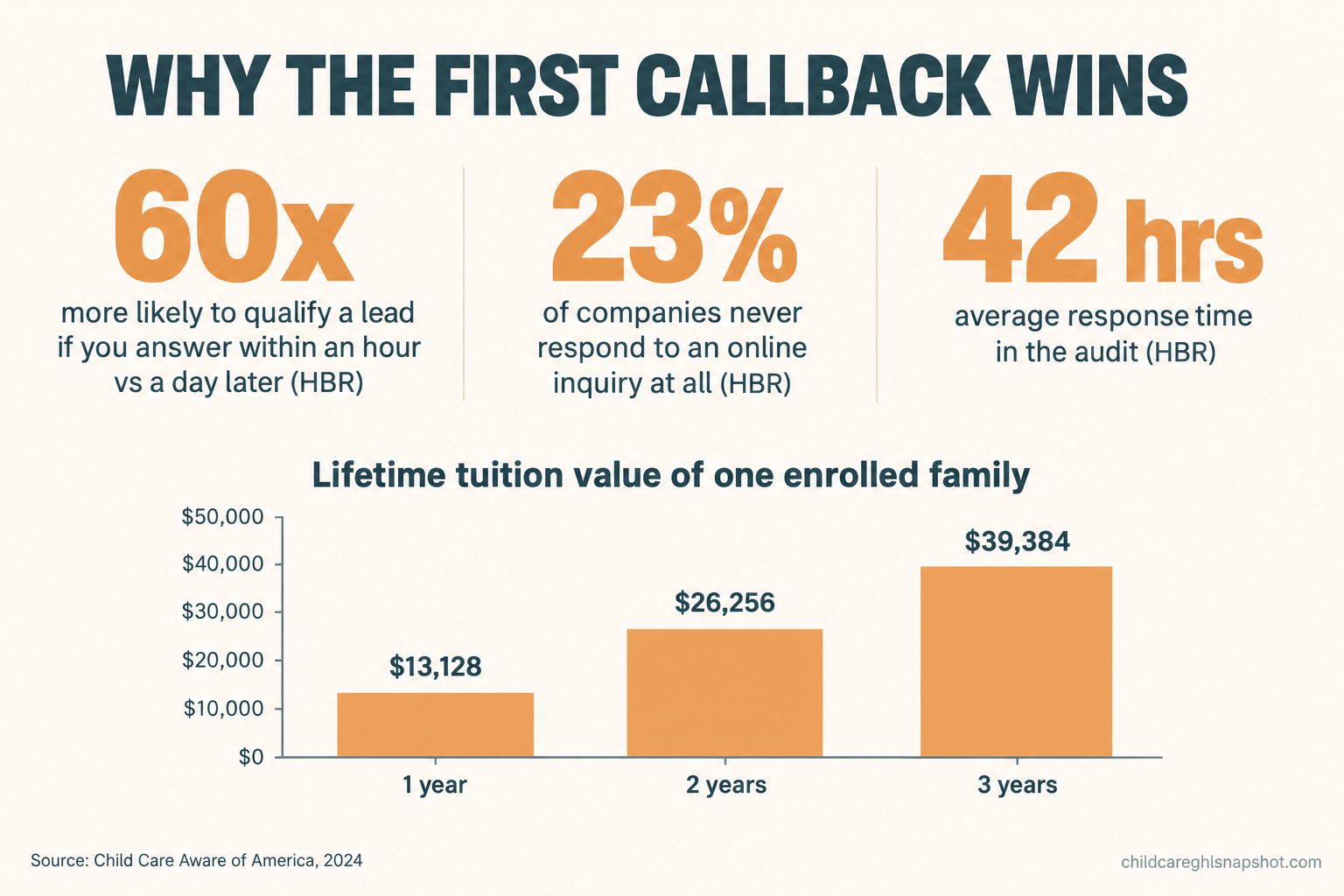
The data behind this comes from sales research, not childcare, because speed-to-response behaves the same way no matter what you sell. Harvard Business Review’s audit of 2,241 US companies found that only about 37% answered a web inquiry within an hour, 23% never responded at all, and the average response time was 42 hours. Studying 1.25 million leads, the same researchers found firms that made contact within an hour were nearly 7 times more likely to qualify that lead than firms that waited one more hour, and more than 60 times more likely than firms that waited a day. A separate lead-response study was sharper still: calling within 5 minutes versus 30 made contact about 100 times more likely. You just need to not answer in 42 hours.
Now put a dollar figure on one missed call. The national average price of child care in 2024 was $13,128 a year, per Child Care Aware of America. A family that enrolls an infant and stays two or three years is worth $26,000 to $39,000 in tuition, before siblings and referrals. And demand is not your problem: with 46% of children under 6 living in a licensed child care desert in 2025 per the Center for American Progress, seats are scarce. You are just short on a reliable way to be first.
Lifetime tuition value of one enrolled family at the 2024 national average of $13,128 a year (Child Care Aware of America), before siblings and referrals. Roughly what rides on a single inquiry you answer late.
The first-response system, end to end
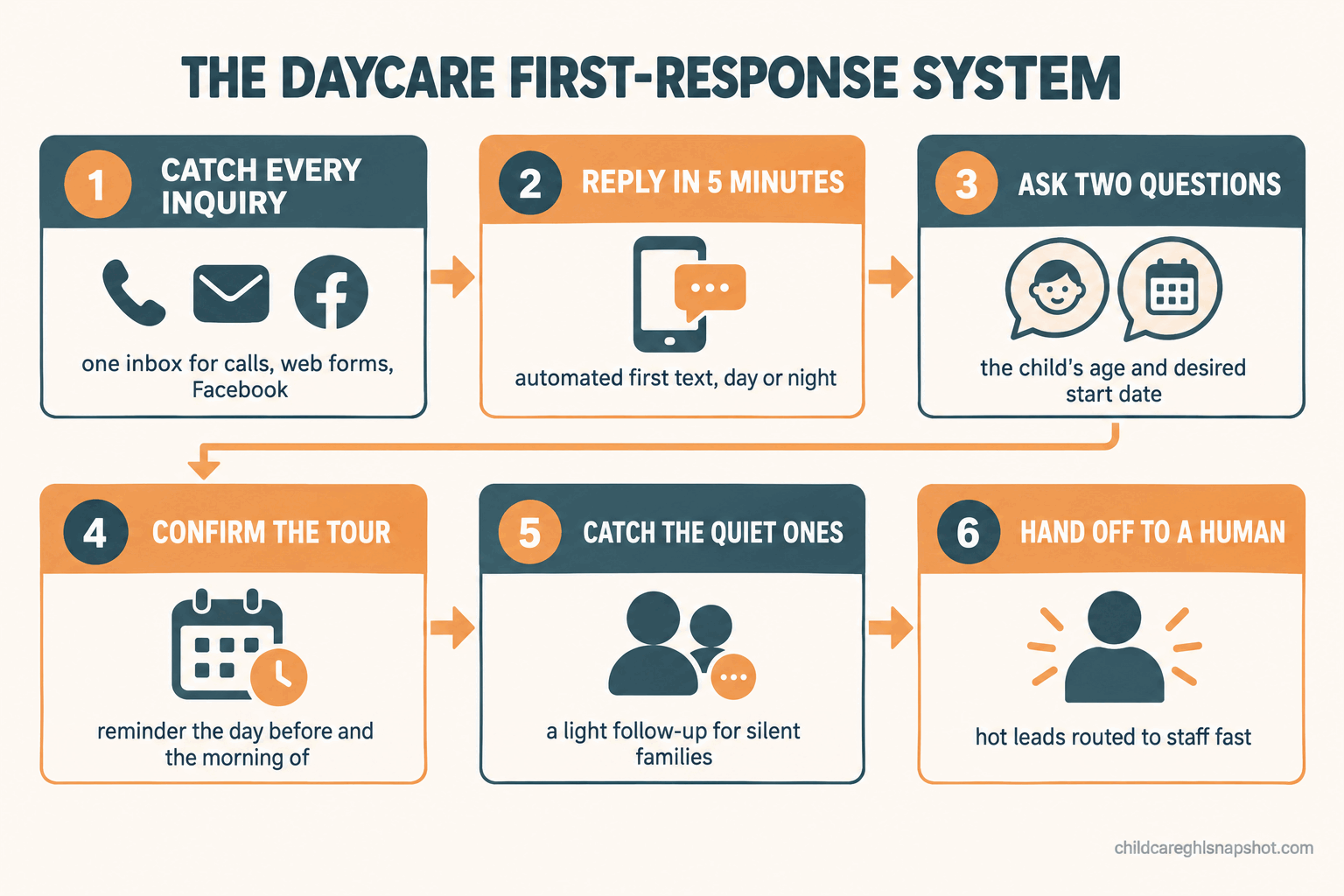
You do not need software to understand the system, but you do need the whole thing, because each stage plugs a gap the others leave open.
Stage 1: Catch every inquiry in one place
This is the stage directors skip, and it is where most of the money leaks out, because you cannot answer fast if you do not know an inquiry came in. Your leads are scattered: the center phone and its voicemail, your personal cell, a web form that emails an inbox you check between activities, Facebook and Instagram messages, and the parent who walks in at pickup. Each is a different place, and a busy morning swallows half of them. The fix is one inbox: every channel routes into a single place where a new inquiry is obvious.
How this breaks: The personal-cell lead dies in a voicemail cleared on Friday, so route the center’s main number to fire a text back on any missed call during care hours. The dead web form is the other leak: fill yours out from your phone, and if a reply takes hours, you found a leak worth thousands.
Stage 2: Reply in five minutes, even at nap time
A human cannot reply in five minutes at 9:20am or 8:30pm while covering ratios. An automated first text can, and that is the single most powerful piece in this post. The instant an inquiry lands, a text goes out in your voice: a warm hello, confirmation you got the message, and two concrete tour times. That stops her dialing the next place.
How this breaks: Two ways. First, the auto-reply that sounds like a robot (“Your inquiry has been received and is important to us”) loses the warmth that makes a parent trust you with her child. Second, and this one is silent, the text that never sends because your number is not registered for A2P 10DLC. Carriers block unregistered traffic, so the automation quietly delivers nothing.
Stage 3: The two questions that book a tour
Speed gets the parent talking. Directors overcomplicate what comes next. You need two answers: how old is the child, and roughly when do you need care. Age tells you the room and whether you are at ratio; start date tells you whether this is a “come Thursday” or a “let us save you a spot” conversation. The automated reply can ask both in one line: “Happy to help. How old is your little one, and when were you hoping to start?”
How this breaks: The over-qualifying form, where a long intake sits behind the inquire button and the parent abandons it. Ask the minimum up front and collect the rest at the tour. The other failure is treating “no spot right now” as a dead end. A full infant room today is a family who will pay you $13,000 a year when a spot opens, if you keep them warm: that is a waitlist, not a rejection, and it has its own system.
Stage 4: Confirm the tour so it actually happens
A booked tour is not an attended tour. A tour booked Monday is easy to forget by Thursday, so every one needs a confirmation the day before and a reminder the morning of, with your address, a photo of the room they will see, and a one-tap reschedule link. That link matters more than it looks: a parent who cannot make Thursday will usually just not show rather than call, because canceling feels rude. Give her an easy “need a different time?” and she rebooks instead of vanishing.
How this breaks: Reminders that feel like a collections notice. “This is a reminder of your scheduled appointment” is cold; “Can’t wait to show you the toddler room tomorrow at 10, here’s a peek” is a center a parent wants to visit. The other failure is no reminder at all, because the booking lived in a paper calendar. If no-shows eat your week, see my playbook on cutting daycare tour no-shows.
Stage 5: Catch the families who go quiet
Some parents will not answer the first text, or will book and then go silent. That is normal. Silence is a not-yet, not a no, and a light follow-up wins a surprising number back: one friendly check-in the next day, a second a few days later with something useful like your tuition range, and a final soft nudge about a week out. Be the center that stayed in gentle contact while the others sent one reply and gave up.
How this breaks: Following up too hard, too fast. Five texts in two days feels like pressure and earns a STOP reply. The opposite failure is giving up after one, when the parent who ignores your first text is often the one who enrolls after the third. For why families disappear after a visit, see why parents go quiet after a daycare tour.
Stage 6: Hand the hot ones to a human fast
Automation’s job is to open the door, not to close the enrollment. The moment a parent replies with a real question (“do you offer part-time?”, “can I come today?”), a human needs to take over, because the handoff is where warmth and judgment matter. A hot reply should ping whoever handles enrollment by text or a notification they will actually see, not an email buried under licensing paperwork.
How this breaks: The notification nobody sees. If a ready-to-enroll reply lands in a shared inbox checked at 4pm, you have rebuilt the slow-callback problem one step later. The opposite failure is routing every text to a human, so the director drowns and ignores the alerts. Let automation handle the “got it, here are two times” traffic, and pull a person in only for a real question or a ready buyer.
Steal these: the first-contact messages
The system is only as good as the words in it. Here are the messages to copy and reuse. Keep your own voice, but keep them this short, because long texts read like marketing and get ignored.
The missed-call text-back:
Hi, this is Dana at Sunrise Learning. So sorry we missed you, we were with the children! Were you calling about enrollment? I can help right here by text. How old is your little one?
The after-hours web-form auto-reply:
Hi [first name], thanks for reaching out to Sunrise Learning! I’d love to show you around. I have two tour times open this week: Wednesday at 10am or Thursday at 4pm. Which works better? And how old is your child?
The qualifying follow-up (if she gives an age but no start date):
Perfect, we have lovely space in our toddler room. When were you hoping to start? That tells me whether we can get you in now or save you a spot.
The tour confirmation (the day before):
Hi [first name], we can’t wait to meet you and [child’s name] tomorrow at 10am! We’re at 412 Oak Street, park out front. Here’s a peek at the room you’ll see: [photo]. If tomorrow stopped working, grab a new time here: [link].
The quiet-family check-in (next day, if she booked nothing):
Hi [first name], no rush at all, choosing care is a big decision. If it helps, our toddler tuition runs [range] and we have a spot opening in [month]. Happy to answer anything by text. Would a quick tour this week help?
Written once and wired to fire on the right trigger, they are the difference between the center that called back and the one the parent forgot.
Run it three ways
The same six stages scale up and down.
Solo operator, one site, 30 to 50 children. Automation is not a luxury here, it is the only way you get first-response speed at all, because you cannot answer a phone while holding a toddler. Lean hard on the Stage 2 auto-text, and point the human handoff at your own cell for hot replies only, so you are pulled off the floor for ready buyers, not routine confirmations.
Mid-size, one or two sites, 60 to 100 children. You likely have an office person or assistant director who can own enrollment, so the system’s job is to make sure inquiries never depend on whether that person is at their desk. Route every channel into the shared inbox, let automation cover nights and the hours your lead is in a classroom, and watch the handoff gap when they are out sick.
Multi-site, three or more locations. Your risk is a Site B inquiry landing with Site A’s front desk and dying there. Capture location up front, route each site’s inquiries to its own enrollment person, and centralize the reporting so you can see which site answers fast, because at three sites the slow one is invisible until you measure it. The math on what each empty classroom costs makes the case for fixing it fast.
The compliance part you cannot skip
Texting parents is the engine of this system, so run it legally. Getting the rules wrong is expensive and, worse, can silently stop your texts from sending.
First, the TCPA governs automated texts, with statutory damages of $500 per violating message and up to $1,500 for a willful violation. The part that helps you: a reply to a parent who just contacted you is an operational response, not marketing. Keep first-response texts transactional (confirming, scheduling, answering) and you are on solid ground. Risk appears when you send promotional broadcasts to that list without consent. Second, A2P 10DLC is the registration every US business needs to text from a regular 10-digit number, done through your texting provider with The Campaign Registry; skip it and carriers block your messages silently.
Third, the childcare-specific rule people forget. FERPA generally does not apply to private licensed daycares, so do not let anyone tell you it binds your marketing. What binds you is your state’s licensing rules on child-record confidentiality and photo consent. Never name or show a specific child in marketing without consent on file, and that consent cannot be a condition of enrollment. Keep anything touching a child’s attendance or health data in the parent-only channel. The full breakdown is in the 2026 guide to texting daycare parents legally.
Objections I hear from directors
“Won’t an automated text feel cold and impersonal?” It feels worse to not hear back at all, which is what parents get from most centers today. A warm, short text in your voice that arrives in thirty seconds feels more caring than a polished callback two days later, as long as you write it the way you actually talk.
“I already pay for Brightwheel or Procare. Doesn’t it do this?” Those are good tools for running your center once a family is enrolled: billing, daily reports, check-in, ratios. They are not built to catch a Facebook message at 9pm and text a prospective parent back in thirty seconds, and most charge per child. The first-response system sits in front of them and feeds enrolled families in. If you are weighing cost, I broke down what childcare software actually costs in 2026.
“Do I need to be technical to run this?” No. You set it up correctly once, and then it runs on triggers you do not touch: a missed call, a form, a booked tour. Your only ongoing job is to answer the hot replies a human should. If you can run a tablet check-in app, you can run this.
“What if I don’t have the volume to justify it?” This is backwards. The fewer inquiries you get, the more each one matters, and the less you can afford to lose one to a slow callback. Scarce leads are the argument for answering fast, not against it.
Your questions, answered
How fast do I really need to respond to a daycare inquiry?
Faster than the center down the road, which means minutes, not hours. HBR found firms responding within an hour were about 60 times more likely to qualify a lead than those who waited a day. An automated first text covers the window where parents are still shopping, and a human follows up within the hour.
What is speed-to-lead and does it apply to childcare?
Speed-to-lead is how fast you respond to a new inquiry. It was studied in sales, but it applies anywhere people shop several options at once, which is exactly how parents choose a center: they call three or four, and the first helpful response usually wins the tour.
Is it legal to send automated texts to parents?
Yes, done right. A reply to a parent who just contacted you is an operational, transactional message and carries low risk under the TCPA. You must register your number for A2P 10DLC, or carriers block the messages. Keep health and attendance data in the parent-only channel, and never market a child's name or photo without written consent on file.
Won't parents be annoyed by follow-up texts?
Not if they are short, useful, and spaced out: one check-in the next day, one a few days later with helpful info, and a soft nudge about a week out. Five texts in two days is pressure and earns a STOP reply.
Do I need to replace Brightwheel or Procare to do this?
No. Your childcare management software runs the center after a family enrolls. The first-response system sits in front of it, catching and converting inquiries, then handing enrolled families off to the tool you already use. It is the layer most centers are missing.
What is the single biggest leak to fix first?
The missed call during care hours and the web form that goes to an inbox nobody watches. Fix those two and you recover inquiries you did not know you were losing. Test your own web form now by filling it out from your phone.
So go back to that Tuesday morning. Same scenario, but now you do not have to put a child down to answer. The missed call fired a text in your voice within seconds. The mom got two tour times before she dialed the next center, picked Thursday at 10, got a confirmation the night before, and walked in to a director who already knew her child’s name. She enrolls. The center across town never got the chance, because you called back first.