

It is a Tuesday in September and you are looking at a waitlist with forty-one names. Two infant spots opened this morning because a family gave notice. Somewhere in that list are parents who would take those spots today, but you do not know which two, half the names are from a spreadsheet you last touched in March, and by the time you work through it one family has deposited somewhere else.
Here is the short version, so you can fix it this week. A waitlist is not a list, it is a pipeline, and it only works if every family moves through the same steps: captured, sorted, answered fast, kept warm, and given a real offer with a deadline when a seat opens. Most centers do the first step and skip the rest, which is why a full waitlist and empty classrooms sit side by side.
What this post covers
- What a leaking waitlist really costs you
- The six-stage waitlist system
- Stage 1: Capture every family in one list
- Stage 2: Sort so you know who to call first
- Stage 3: Reply in minutes, not days
- Stage 4: Keep waiting families warm
- Stage 5: When a seat opens, offer it with a deadline
- Stage 6: Turn the yes into a paid enrollment
- Run it three ways
- The compliance part you cannot skip
- The objections I hear from directors
- Your questions, answered
What a leaking waitlist really costs you
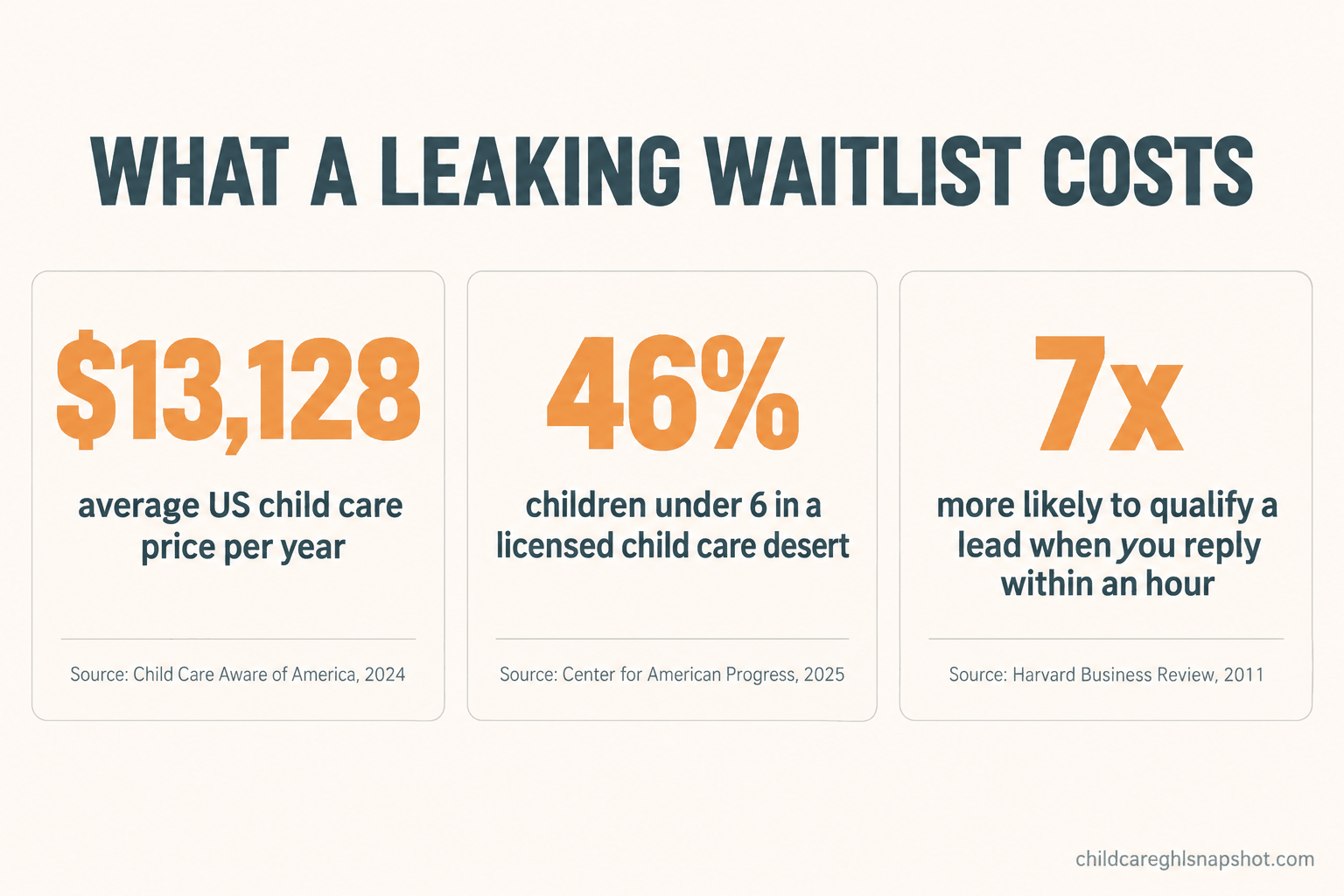
Start with the money. The national average price of child care hit $13,128 a year in 2024, according to Child Care Aware of America, and infant care runs higher because the staffing ratios make each infant seat expensive to offer. One infant spot empty for three months is a few thousand dollars that does not come back. And families do not enroll for a month, they enroll for years, so at the national average a family who stays from infancy through preschool represents $26,000 to $39,000 in tuition. One empty seat compounds.
The demand is there. An estimated 46 percent of children under age 6 live in a licensed child care desert, the Center for American Progress reported in 2025, meaning more than three young children for every licensed slot. The Bipartisan Policy Center counts about 4.2 million children who lack a formal slot, and the count on state child care subsidy waitlists nearly doubled between 2024 and 2025. The bottleneck is almost never demand. It is that the waitlist is a name graveyard instead of a pipeline.
The most expensive waitlist failure is not the parent who says no. It is the parent who was ready to say yes, sat in your list for six weeks, got a call back from a competitor first, and enrolled there. You never see that on a report. It shows up as a classroom that stays one child short.
The six-stage waitlist system
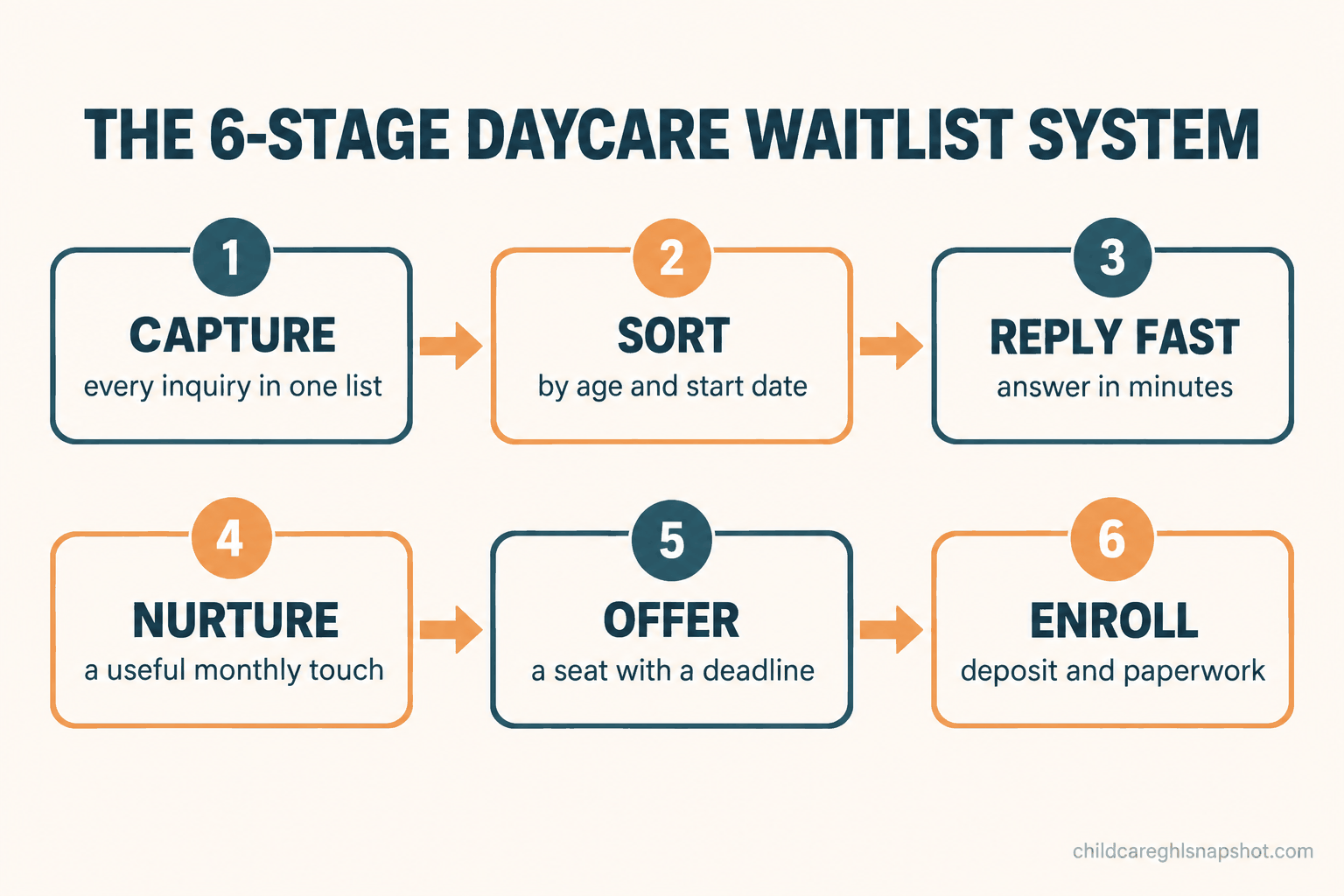
Every center that fills seats runs some version of the same six stages, in a spreadsheet or fully automated. The stages do not change.
- 📝Stage 1
Capture
Every inquiry in one list, with the child's age, start date, and contact.
- 🔢Stage 2
Sort
Rank by start date, age band, and urgency, so an opening maps to a short list.
- ⚡Stage 3
Reply fast
Answer every inquiry in minutes with a real next step. The first reply usually wins.
- ☕Stage 4
Nurture
A low-pressure monthly touch keeps families warm and your list honest.
- 🎟️Stage 5
Offer
When a seat opens, offer it with a deadline, then move to the next family.
- ✅Stage 6
Enroll
Turn the yes into a deposit, signed paperwork, and a confident first day.
Stage 1: Capture every family in one list
You cannot work a list you cannot see. Parents reach you six ways: a form on your site, a Facebook message, a Google listing, a call, a walk-in, a referral. If those live in six inboxes, you have six half-lists, and the parent who messaged you at 9pm is invisible by Thursday.
For every family, capture four things: the child’s age band, the desired start date, the parent’s name and best contact, and the source.
How it breaks. The sticky note, where a name goes on a pad during pickup chaos and never reaches the system. The dead form, where your website emails a notification nobody watches. The split brain, where the front desk keeps paper and the director a spreadsheet, neither matching. Fix all three by funneling every source into one intake, whether a sheet you maintain or the CRM and workflow automation that catches web, social, and call inquiries at once.
Stage 2: Sort so you know who to call first
When a spot opens, you should answer one question in ten seconds: who are the two or three families this seat is for?
Sort by three things. Age band, because an infant opening is not a preschool opening. Start date, because a family who wanted care in August is more ready than one planning for spring. And urgency, because a parent going back to work in three weeks is hotter than one casually looking. The point is not a perfect algorithm, it is calling a ranked short list when a seat opens, not the whole thing.
How it breaks. First-come-first-served applied blindly, so you offer an infant seat to the family at the top who wanted next year, they say not yet, and you have burned a day. Or the stale sort, where a family who enrolled elsewhere still sits at position two. Re-rank whenever you touch the list.
Stage 3: Reply in minutes, not days
This stage decides more enrollments than any other, and most centers lose it. Parents shopping for care are messaging three or four centers in the same hour. Whoever answers first, with a real next step, gets the tour.
The research is blunt. In a study of more than 2,200 companies, Harvard Business Review found that firms which respond within an hour are about seven times more likely to qualify the lead, and 60 times more likely than those who wait a day. The average responder took 42 hours.
A lead answered within an hour is roughly 60 times more likely to be qualified than one answered after 24 hours. Source: Harvard Business Review, “The Short Life of Online Sales Leads,” 2011.
You will not sit on your phone all day, and you should not have to. The fix is an instant automated first reply that books the next step: a missed call becomes a text in seconds, a form fill gets a tour link. That is what the SMS automation and tour booking flows are for, backed by a human follow-up.
How it breaks. The inquiry arrives at 8:30pm and is seen at 11am, after the parent booked elsewhere. Or the reply is a dead-end “we will get back to you” with no way to book. Or the auto-reply fires but no human follows up, so a parent who replies hits silence. Speed opens the door, a person still walks them through it.
Stage 4: Keep waiting families warm
Here is the stage almost nobody runs, and it is where the quiet money is. Most waitlisted families are waiting, and while they wait they keep looking. Hear nothing for two months and you become the place that never called back, cold-calling your own list when a seat opens.
The fix is a light, useful monthly touch. Not “any update?” every week, which reads as desperate. One helpful message a month that reminds them they are still on the list and worth waiting for: a photo from the room, a quick “we are still holding your place.” Always let a family who has moved on tell you, so your list stays honest.
How it breaks. Silence, where the list is touched only when a seat opens, so every offer is a cold call. Or the opposite, pestering weekly until a family mutes you. Monthly, useful, and easy to reply to is the rhythm that works. If that is another job you do not have, the enrollment automations run it once you write the messages.
Stage 5: When a seat opens, offer it with a deadline
A spot opens. This is the moment the whole system exists for, and easy to fumble by being too soft. The weak version is “a spot opened, let me know if you are interested.” It is vague and invites a parent to forget.
The strong version is a specific offer to a specific family with a real deadline: the room, the start date, the tuition, and a short window to claim it. You know who to call first, and they are glad to hear from you. Give the first family about 48 hours to say yes and put down a deposit. If they pass, move to the next family. A small, refundable deposit turns a soft yes into a commitment and protects you from the parent who agrees and never shows.
How it breaks. The soft offer with no deadline, because “let me know” sits for a week while another center closes the family. Or no deposit, so a parent commits verbally and ghosts on day one.
Stage 6: Turn the yes into a paid enrollment
A yes is not an enrollment. Between “I will take the spot” and a child walking in on day one, families fall through more than directors admit. Stage 6 closes that gap while the parent is still excited.
The moment a family says yes, three things happen at once. The deposit link goes out and gets paid, which is the real commitment. The paperwork goes out as a form they finish on a phone, not a PDF they must print, sign, and scan. And you set an expectation for day one: what to bring, when to arrive, who greets them. A family who pays and completes forms within a day rarely falls out. A family told “we will send it sometime this week” gets a week to cool off. This is the seam between your waitlist and your enrollment funnel, and should feel like one motion.
How it breaks. The paperwork that needs a printer, because half of parents never finish it. The slow deposit ask, where shyness about money leaves the seat unclaimed. And the silent first week, where a family enrolls and hears nothing until they arrive nervous. Mobile forms, an immediate deposit link, and one warm “here is what day one looks like” message close all three.
Run it three ways
The six stages are the same at every size. The effort and the stakes are not.
The home daycare (8 to 12 children). Your list is short but every seat is a big share of your income. You lose families at Stage 3, because you are teaching all day and cannot answer in the moment. The highest-return move is one automated instant reply that books a tour, plus a simple monthly nurture. An afternoon of setup, once.
The single center (40 to 80 children). Volume makes the pipeline real, so a spreadsheet starts dropping people. A proper intake, a ranked list your front desk and director both see, and automated nurture pay for themselves. The failure here is the split brain from Stage 1: two lists that disagree. Consolidate to one, on autopilot.
The multi-site group (100-plus children). Now it is a systems problem, because a family often does not care which of your sites they get into. Without one shared pipeline, a parent waitlisted at Location A never gets offered the seat that opened at Location B two miles away. Standardize the stages, centralize the list so cross-site offers work, and automate the reply and nurture so no location’s inquiries rot.
The compliance part you cannot skip
Because a lot of this runs on text messages, a few rules bind you, and the full 2026 texting guide has the detail. Marketing texts need prior express written consent, so put an unchecked opt-in checkbox on your forms and never blast an old list. Register your business number for A2P 10DLC, done through The Campaign Registry, or US carriers quietly filter your texts into nowhere and kill the speed-to-lead stage. Under the Telephone Consumer Protection Act, a non-consented blast carries statutory damages per message. Give every text a clear “reply STOP,” and keep your operational parent channel separate from your marketing list.
The objections I hear from directors
“My waitlist is already full. Why do I need a system?” A full list and full rooms are different things. I have watched centers with sixty names run a classroom a child short for a month, because nobody could work the list fast enough when a seat opened. Full is only useful if it converts.
“This feels like too much automation for a warm business.” It is the opposite. Automation handles the timing you would otherwise forget, so your human attention lands on the tour and the first day. A parent does not feel processed because you texted back fast, they feel relieved, because the other three centers still have not answered.
“I already pay for Brightwheel or Procare. Isn’t this handled?” Those tools run your center once families are enrolled: attendance, daily reports, billing. They are not enrollment and waitlist marketing tools. The moment you are nurturing waiting families and racing a competitor to call back first, that is a different job, and I mapped the lines in the pricing teardown.
“Do I need to be technical?” No. You need the messages written once, mostly the copy in this post in your own voice, and the stages wired together. Build it in GoHighLevel yourself, or have it installed. The hard part is deciding the stages and the copy, and you just read both.
Your questions, answered
How do I turn a daycare waitlist into actual enrollments?
Treat it as a pipeline: capture every inquiry in one place, sort by age band and start date, reply within minutes, nurture waiting families monthly, offer an open seat with a 48-hour deadline and a deposit, then finish enrollment with mobile forms. The families were willing. The system converts them before a competitor does.
How fast should I respond to a childcare inquiry?
Within an hour at the outside, ideally minutes. Harvard Business Review found that responding within an hour makes a lead about seven times more likely to qualify, and 60 times more likely than waiting a day. Parents message several centers at once, so an instant automated reply that books a tour wins more enrollments than anything else.
How often should I contact waitlisted families?
About once a month, with something useful rather than a bare 'any update?'. A photo from the room, or a friendly 'still saving your place', keeps you top of mind and lets families who moved on tell you, which keeps your list honest.
What should I say when a spot finally opens?
Make a specific offer to the top family: the room, the start date, the tuition, and 48 hours to claim it with a deposit. If they pass, move to the next family. A vague 'let me know if you are interested' is how open seats sit empty for weeks.
Should I charge a waitlist or enrollment deposit?
A small, clearly-explained deposit turns a soft yes into a real commitment and protects you from families who agree and never show. Make the terms plain, and check your state's licensing and consumer rules before setting the amount.
Is it legal to text families on my waitlist?
Yes, with consent. Marketing texts require prior express written consent, so use an unchecked opt-in checkbox, register your number for A2P 10DLC so carriers do not filter your messages, and include a STOP option. Keep your parent channel separate from your marketing list. Our 2026 texting guide has the full rules.
So, back to that Tuesday and the two open infant spots. You open a list that is already sorted, see the two families whose ages and start dates fit, and send each a specific offer with a 48-hour deadline and a deposit link. Both have heard from you every month, so the message is welcome. One replies within the hour and pays that afternoon. The room is full by Friday, the family stays for years, and you spent five minutes on it. If you want the instant replies, the monthly nurture, and the seat-open offers built this way from the start, that is what a done-for-you system is for.