

It is 6:04pm. The center closed at six. Nineteen of your twenty families are long gone, the floors are mopped, and Miss Dani already has her coat on. One four-year-old is still here, backpack on, sitting by the cubbies and watching the door. His mom is not answering her phone. Dani cannot leave him, and because your license will not let one adult be alone with a child at close, you cannot leave either. So two of you stand around at $16.82 an hour while a parent who is “five minutes away” is actually twenty.
Late pickups are not a discipline problem. They are a system problem, and you fix them with four things: a written policy the parent actually agreed to, a clear definition of when the clock starts, a short automated text sequence that warns the parent before and after close, and a fee that bills itself so you never have the awkward money conversation at the door. Build those once and it runs without you standing in the parking lot doing mental math.
What this post covers
- What a late pickup actually costs you
- The late-pickup system, end to end
- Stage 1: A policy parents actually agreed to
- Stage 2: Define “late” and start the clock
- Stage 3: The heads-up before close
- Stage 4: The after-close reminder and fee notice
- Stage 5: Bill the fee without the guilt conversation
- Stage 6: Handle the chronic late family
- Steal these: the four texts
- Run it three ways
- The compliance part you cannot skip
- Objections I hear from directors
- Your questions, answered
What a late pickup actually costs you
Directors underprice this. They picture a ten-minute delay on a Friday. The bill lands in three places.
First, staff wages. A childcare worker earns a median of $16.82 an hour per the Bureau of Labor Statistics May 2025 data. Per incident that sounds trivial, until your licensing rules get involved. Most states will not let a single adult be alone with children, and your age ratios still apply after six, so the one child left behind usually pins two staff, not one. Twenty minutes, twice a week, two teachers each time, is not a rounding error over a year.
Annual staff-wage cost of late pickups, assuming two teachers held per incident at the BLS median of $16.82/hour. Illustrative math on wages only, and it ignores the bigger costs below. Source: U.S. Bureau of Labor Statistics, OEWS, May 2025.
Second, and this one actually hurts, your closing staff. The Federal Reserve Bank of Cleveland found childcare turnover in 2022 ran about 65% higher than a typical occupation, and that roughly half of childcare workers who leave a job leave the workforce entirely. The teacher who stays until 6:25 three nights a week starts wanting a job with a hard stop. You cannot fix wages overnight, but you can stop burning your closers out over something a text and a fee would solve. Protecting their evenings is near the top of my playbook on keeping teachers without raising tuition.
Third, and quietly, late pickups spread. One family learns 6:15 is fine, another notices, and your close drifts to 6:20 for everyone. You are not short on demand. With 46% of children under age 6 living in a child care desert as of 2025, down from 51% in 2018 per the Center for American Progress, seats are scarce. You are short on the operational discipline that keeps good staff and a clean close, and late pickups eat exactly that.
The late-pickup system, end to end
You do not need software to understand the system, but you do need the whole thing, because every piece covers a gap the others leave.
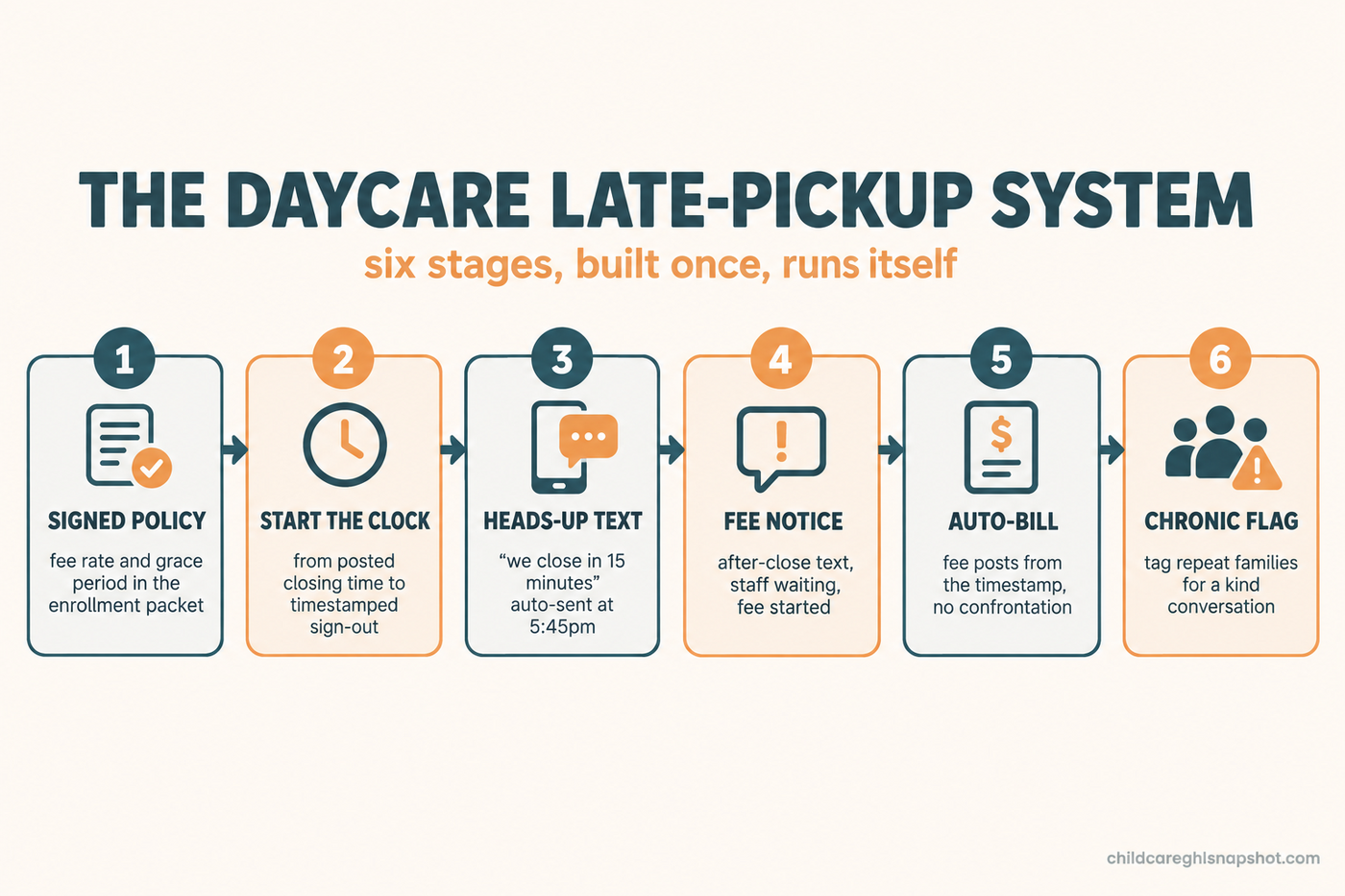
The order matters. The policy comes first because nothing downstream is enforceable without it. The warning text comes before the fee because your goal is fewer late pickups, not more fee revenue. And billing comes last and automatically, because the biggest reason centers never collect late fees is that they rely on a tired staffer to remember, do the math, and ask a parent for money at the door. Nobody wins that conversation. Let the system have it. Six stages, each with the way it breaks in real centers, because the breakage is where the money leaks.
Stage 1: A policy parents actually agreed to
A late fee you did not get a signature on is a suggestion. When a parent disputes the charge, and one will, the only thing that holds up is a policy they agreed to in writing at enrollment.
Your policy needs four numbers and one sentence: your closing time, the grace period, the fee rate, how the fee is billed, and that the parent agrees to all of it. Put it in the enrollment packet with its own checkbox, so the parent actively ticks “yes, I understand the late-pickup fee” rather than initialing page nine. Be specific about the rate. “A late fee may apply” collects nothing. “$1 per minute after a 10-minute grace period, billed to your account” collects. A per-minute rate is the most common structure: Procare ships a default “after hours pickup” rate of $1.00 per minute. Some centers use a flat tier like $15 per 15 minutes, simpler but harsher for a two-minute slip.
How it breaks. The policy lives only in the handbook, so no parent agreed to the dollar amount and the first dispute wins. Or it names a fee but never says how it gets paid, so it stays a note in a file. Fix it at the source: one signed checkbox, rate and billing method named, captured the day the child enrolls.
Stage 2: Define “late” and start the clock
“Late” sounds obvious until a parent argues it. Your close is 6:00. A parent walks in at 6:03 but their child is not ready until 6:11 because they are finishing a snack and finding one shoe. When did the clock stop? Decide before it happens, not in the doorway.
Pick the simplest defensible rule: the clock runs from your posted closing time until the parent arrives and signs out. A short grace period, five to ten minutes, is humane and cuts disputes, because the parent two minutes behind traffic does not get a bill and resent you for it. Tie the clock to a timestamp everyone can see. A tablet check-in app gives you an objective time; a paper sheet gives you whatever the parent wrote, and parents write 6:05 when it is 6:18.
How it breaks. The usual failure is a soft start time: staff feel bad, “give it a few minutes,” and the real close drifts to 6:10. The other is a disputed timestamp on paper, where you lose every argument. Move sign-out to a timestamped system and the clock stops being a debate.
Stage 3: The heads-up before close
This is the stage most centers skip, and the one that actually reduces late pickups. A parent is rarely late on purpose. A single text at 5:45 that says “we close in 15 minutes” turns a 6:20 pickup into a 5:58 one, because it jolts them while there is still time to leave.
Make it automatic and kind. The message goes to any family whose child is still checked in a set number of minutes before close. It is a reminder, not a warning shot, with no fee language yet. This is what SMS automation is built for: it fires off your check-in status, not off someone remembering.
- 📲5:45pm
Still checked in?
Auto-text to families whose child is still signed in, 15 minutes before close. Friendly, no fee mentioned.
- 🕕6:00pm
Close
The clock starts. Grace period begins now.
- ⏱️6:10pm
Past the grace
Second text: staff are waiting, the fee has started, please confirm your ETA.
- 🧾Next day
Fee posts
The fee is calculated from the sign-out timestamp and added to the account automatically.
How it breaks. The text goes to everyone, including families who already left, because it is not tied to who is still checked in, so on-time parents get a nag and think your system is broken. Tie the trigger to live check-in status, and fire it from your system, not a staffer’s personal phone that dies the night they are off.
Stage 4: The after-close reminder and fee notice
If the heads-up did not work and it is now 6:10, the second message does two jobs: it tells the parent staff are waiting with their child, and it says, plainly, that the fee has started. This is what makes the fee feel fair later, because the parent was told in real time, not surprised by a line item next week.
Keep it factual. It names the child, stays calm, gives the parent something to do, and puts the fee on the record. No guilt, no exclamation marks: you are documenting, not scolding. And if the parent replies “10 minutes,” a human should see it, so your closer knows when the child is leaving instead of the reply vanishing into a void.
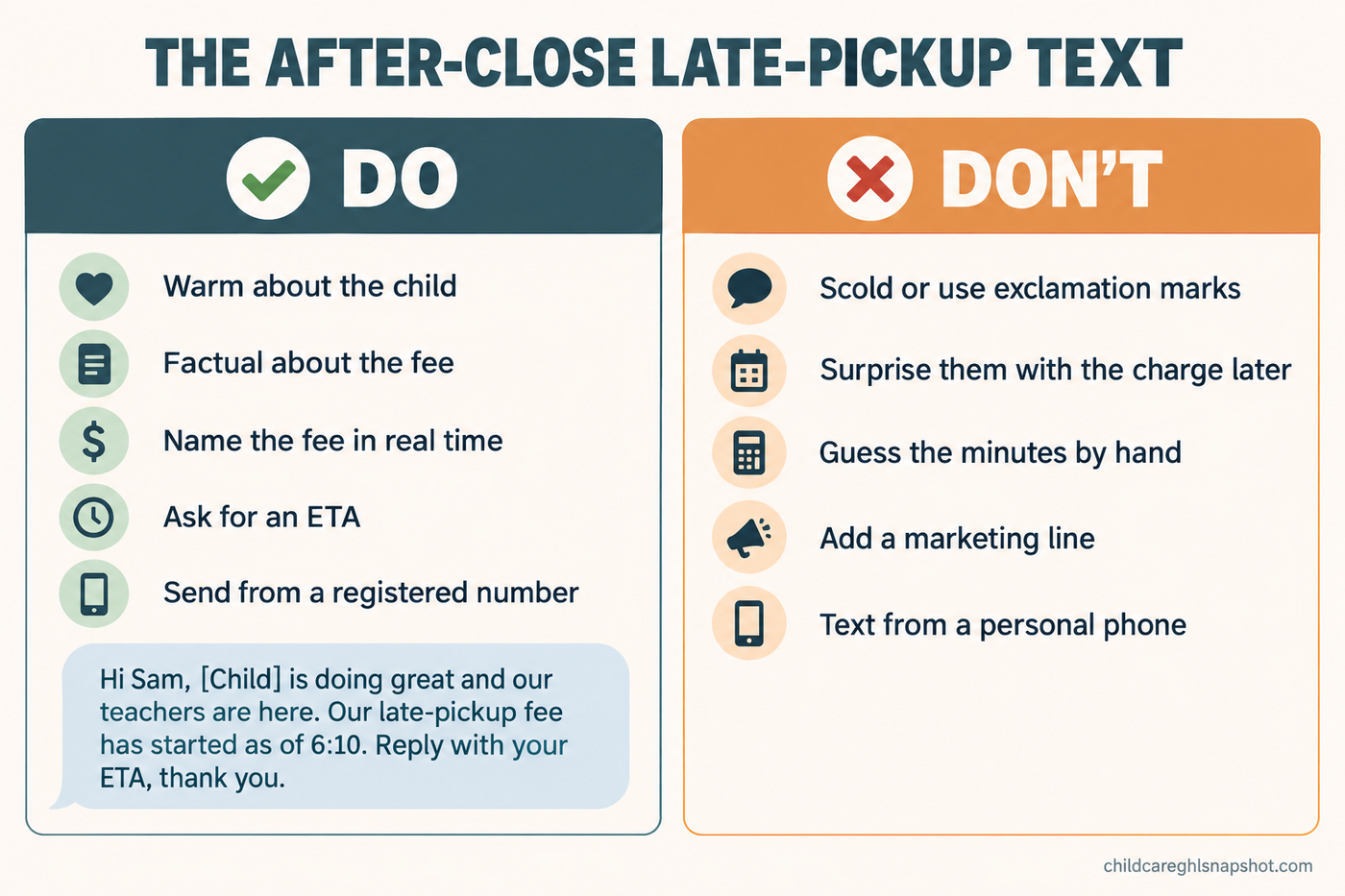
How it breaks. The text never mentions the fee, so the charge is a surprise later and the parent disputes it, fairly. Or the opposite: the message is angry, the parent feels judged, and a good family starts shopping for a center that does not make them feel like a bad parent over one rough Tuesday. Warm about the child, factual about the fee, every time, which is easier when the words are written once into an automation than typed by a stressed closer at 6:12.
Stage 5: Bill the fee without the guilt conversation
This stage decides whether you actually collect. The reason most centers quietly give up on late fees is not the policy. It is that collecting means a human calculates the minutes, remembers the charge, and asks a parent for money face to face. That conversation is miserable, so it does not happen, and the fee becomes theater.
Take the human out of it. The fee should calculate from the sign-out timestamp and post to the family’s account automatically, the same way tuition does, appearing on the next statement rather than as a confrontation at the cubbies. If you already run tuition auto-pay and billing, the late fee rides the same rails. The real benefit is emotional: your closing teacher never has to be the bad guy. She hands over the child, says goodnight, and the money is handled overnight. That is what makes a late fee sustainable instead of a policy you announce and never enforce.
How it breaks. The classic failure is the charge that keeps running after you waived it as a courtesy, because the note sat in a pile while the charge posted anyway. The second is manual math: a tired staffer bills “about 15 minutes” when the timestamp says 23. Calculate from the timestamp, post automatically, and make a waiver a deliberate action, not a sticky note someone forgets.
Stage 6: Handle the chronic late family
Most late pickups are one-offs: a bad commute, a work emergency, a dead phone. The fee and texts handle those. The case that needs a human is the family late every week, because for them the fee has become a price they will pay, and no automation fixes a parent who decided $20 a week is cheaper than leaving work on time.
Flag them with data, not memory. If your system tags a family after three late pickups in a month, you get a list instead of a vague feeling that “the Morrisons are always late.” Then the conversation is specific and kind: ask whether their work schedule is changing and offer an extended-care option, which is a service you price, not a problem. Sometimes they need to hear the fee rises for repeat lateness, which your policy should allow. And leave room for the genuine emergency: a parent in the ER is a human situation, not a fee one. Your policy should say, in plain words, that the center uses judgment for emergencies. That one sentence keeps the whole system from feeling cold, and it costs you nothing.
How it breaks. Without a flag, chronic lateness hides in your closers’ heads and comes out as resentment, not a plan. With a flag but no conversation, you keep billing a family that has decided to pay, so you have monetized the problem instead of solving it. Surface the pattern early, with a number attached, so you act while it is still a conversation and not a staffing crisis.
Steal these: the four texts
Swap in your center name, close time, and fee. Keep the tone exactly this warm. The whole system lives or dies on these being kind about the child and factual about the fee.
Run it three ways
The system is the same at every size. The effort and the stakes are not.
Home daycare (8 to 12 children). Your exposure is small but your margin for lost evenings is zero, because the late family is holding you in your own home after your own kids need you. You probably do not need billing software. You need the signed policy, a timestamped sign-out even on a cheap tablet, and one automated text before close. Let the before-close nudge do most of the work. A couple of hours of setup, once.
Single center (40 to 80 children). Now the staffing math is real: two teachers held past close several nights a week is a retention problem, not just a wage line. Automate all four texts off your check-in status, tie the fee to your tuition billing so it posts without a human, and flag the families who need the stage-six conversation. This is where “we have a policy” and “our closers actually go home on time” diverge.
Multi-site group (100-plus children). Each location has its own close, closers, and chronic families, and you cannot hold all of it in your head. Standardize the policy and fee across sites so a family cannot argue “the other location doesn’t charge,” run texts and billing from one system so every door enforces it the same way, and pull one report of chronic-late families across all sites. At this scale it belongs inside a larger enrollment and operations workflow, not a manual chore at each door.
The compliance part you cannot skip
Texting parents about late pickup is legal and low-risk, as long as you know which bucket it sits in. The first bucket is operational: a reminder that you close soon, a note that staff are waiting, a confirmation that a fee posted to an enrolled family’s account. Under the Telephone Consumer Protection Act these sit on solid ground as long as the family gave you their number and the message carries no marketing. The second bucket is marketing: “we have spots open,” “refer a friend.” That needs prior express written consent, and getting it wrong runs $500 per message, up to $1,500 for a willful violation, per text, per person. The rule of thumb: the moment you add a promotional line (“and enroll for fall now!”), you drag the text into the marketing bucket. Do not. I go deep on this in the guide to texting daycare parents legally.
One more piece trips up centers, and it has nothing to do with the law. US carriers now require A2P 10DLC registration for any business texting from a standard 10-digit number, done by registering through The Campaign Registry, usually via your texting platform. Skip it and your messages do not bounce, they just silently never arrive, so your 5:45 nudge dies in a carrier filter. Register the number, and always honor a STOP reply instantly, even on operational texts.
The ratio rules are why a late pickup pins two staff in the first place, and they are set by your state. Texas centers operate under 26 TAC Chapter 746, with infant ratios as tight as 1:4, while New York centers under 18 NYCRR Part 418-1 run 1:4 for the youngest infants with a maximum group size of 8. Many states also require at least two staff present whenever children are in care. Check your own handbook, because it decides how many of your people are stuck when one child is still there at 6:15.
Objections I hear from directors
“Won’t a late fee make parents resent us?” Not if you warn them first and keep it factual. The resentment comes from a surprise charge or a scolding, never from a fee the parent agreed to, was reminded about in real time, and sees calmly on a statement. The families who resent a fair, well-communicated fee are usually the chronic-late ones, and that is a stage-six conversation, not a reason to drop the policy for everyone.
“I don’t want to nickel-and-dime families. We’re a caring center.” The fee is not about the dollar. It is about your teachers’ evenings. A center that lets pickups drift because charging feels mean is quietly asking its lowest-paid staff to donate their nights, and those are the staff you cannot afford to lose given what turnover already costs the sector. The caring move is protecting the people who care for the kids.
“Do I need special software?” For a home daycare, no: a signed policy, a timestamped sign-out, and one before-close text get you most of the way. For a center or group, the billing and the chronic-lateness flag are hard to do by hand reliably, and “by hand reliably” is where every late-fee policy quietly dies. You need the fee to post itself and the texts to fire off your check-in status without a human remembering.
“What about a real emergency?” You are not billing a parent whose kid is in the ER, and your policy should say so. Build in director discretion for genuine emergencies: the automation handles the ordinary late pickup, a human handles the human situation.
Your questions, answered
How much should a daycare charge for late pickup?
The most common structure is a per-minute rate, often around $1 per minute after a short grace period, which is the default tools like Procare ship with. Some centers use a flat tier such as $15 per 15 minutes. Pick whichever you can explain in one sentence, name the exact number in your enrollment agreement, and bill it from a timestamped sign-out so it is never arguable.
Is a daycare late fee legally enforceable?
It is enforceable when the parent agreed to the specific terms in writing at enrollment, which is why a fee buried in a handbook nobody signed usually loses the first dispute. Put the closing time, grace period, per-minute rate, and billing method in the enrollment packet with its own checkbox the parent actively ticks, and keep a timestamped sign-out as your evidence.
Can I legally text parents about late pickup?
Yes. A late-pickup reminder or fee notice to an enrolled family who gave you their number is an operational message under the TCPA, the low-risk bucket, as long as it carries no marketing. Keep late-pickup texts factual, register your number for A2P 10DLC so they actually arrive, and honor STOP replies instantly.
Should I give parents a grace period before the fee starts?
A short grace period of five to ten minutes is good practice. It spares the parent genuinely two minutes behind traffic, which cuts disputes and resentment, while still drawing a clean line for the fee. Define it in minutes and run it from your posted closing time to the timestamped sign-out so there is no argument about when the clock started.
How do I stop the same families from always being late?
Flag them with data, not memory. Have your system tag a family after a set number of late pickups in a month, then have a specific, kind conversation: ask whether their schedule has changed and offer an extended-care option if one fits. Chronic lateness is usually a schedule problem you can solve or price, not a discipline problem, but you can only act early if the pattern is visible.
So, back to 6:04pm and the four-year-old by the cubbies. In a center that runs this system, mom got a text at 5:45 and left her meeting, so there is no child at the cubbies at all. On the night she genuinely cannot, she got a calm note that staff are with her son and the fee has started, she replied “10 min,” Dani knew when she was leaving, and the fee posted overnight with no awkward conversation. Same close, same seat filled tomorrow, and your closing teacher went home on time and is still working here next year. That is the point. The late-pickup system is not about collecting a dollar a minute. It is about protecting the people who stayed late, built once so you never again stand in the parking lot doing the math.