

It is 6:52 on a Monday and your lead toddler teacher is in your doorway with her coat still on. She loves the kids. She is not angry. She found a job at the school district that pays two dollars more an hour, with summers off and health insurance, and she starts in two weeks. You say all the right things, close the door, and do the math on what her leaving does to your ratios and the four families in her room.
Here is the short version. You almost certainly cannot win a bidding war on wages, so stop trying. Most of what makes a good teacher leave is not the paycheck by itself. It is the chaos around it: a hiring process that dumps her in a room on day one, a schedule that changes on Friday, no path, and no sign anyone notices she is drowning. Fix those and you keep more people at the pay you already have.
What this post covers
- What staff turnover actually costs you
- Why good teachers really leave
- The retention system, start to finish
- Lever 1: Hire fast, or lose the good ones
- Lever 2: A real first 30 days
- Lever 3: Schedules people can plan a life around
- Lever 4: Recognition that is small and constant
- Lever 5: A pay-and-growth path without a tuition hike
- Lever 6: Hear it before it becomes a resignation
- Run it three ways
- The compliance part you cannot skip
- The objections I hear from directors
- Your questions answered
What staff turnover actually costs you
Most directors feel turnover as stress. It is easier to fix once you see it as money, starting with ratios, which are strict for the youngest rooms. Texas allows one caregiver per four infants under eleven months, under its minimum standards (26 TAC Chapter 746); New York is tighter, one to four for infants with a maximum group size of eight (18 NYCRR Part 418-1). Lose the one qualified person covering that room and you cap or close it until you replace her, and every short day is tuition you cannot bill. Demand is not the problem: about 46 percent of children under 6 lived in a licensed child care desert in 2025, the Center for American Progress reported.
Now the wage trap. The median childcare worker earned $32,050 a year, or $15.41 an hour, in 2024, per the Bureau of Labor Statistics, while the average price one family pays for care hit $13,128 a year, Child Care Aware of America reported.
The squeeze in one picture: a single family’s average annual tuition does not cover half of one teacher’s already below-market salary. Sources: BLS, 2024 and Child Care Aware of America, 2024.
One family’s full tuition does not fund even half a teacher at the median, and parents are already stretched to the wall. So the pay lever is real but small; the other levers are where the fight is won. And one cost never shows on a spreadsheet: turnover disrupts the stable relationships young children need and is linked to poorer outcomes for kids, while continuity of care supports healthy development. A parent notices the fourth new face in the infant room and starts touring elsewhere.
Why good teachers really leave
When I ask directors why someone left, the reflex answer is “the money,” and insufficient pay is indeed the reason educators most often give, NAEYC has reported. But it does not stop at pay. In NAEYC’s look at the sector’s status quo, among educators thinking about leaving, what would keep them was higher wages, yes, but also more support with children’s challenging behavior and more respect on the job.
What educators who were considering leaving said would keep them (they could pick more than one). Forty percent of the answer is something other than pay. Source: NAEYC, “An Unsustainable Status Quo”.
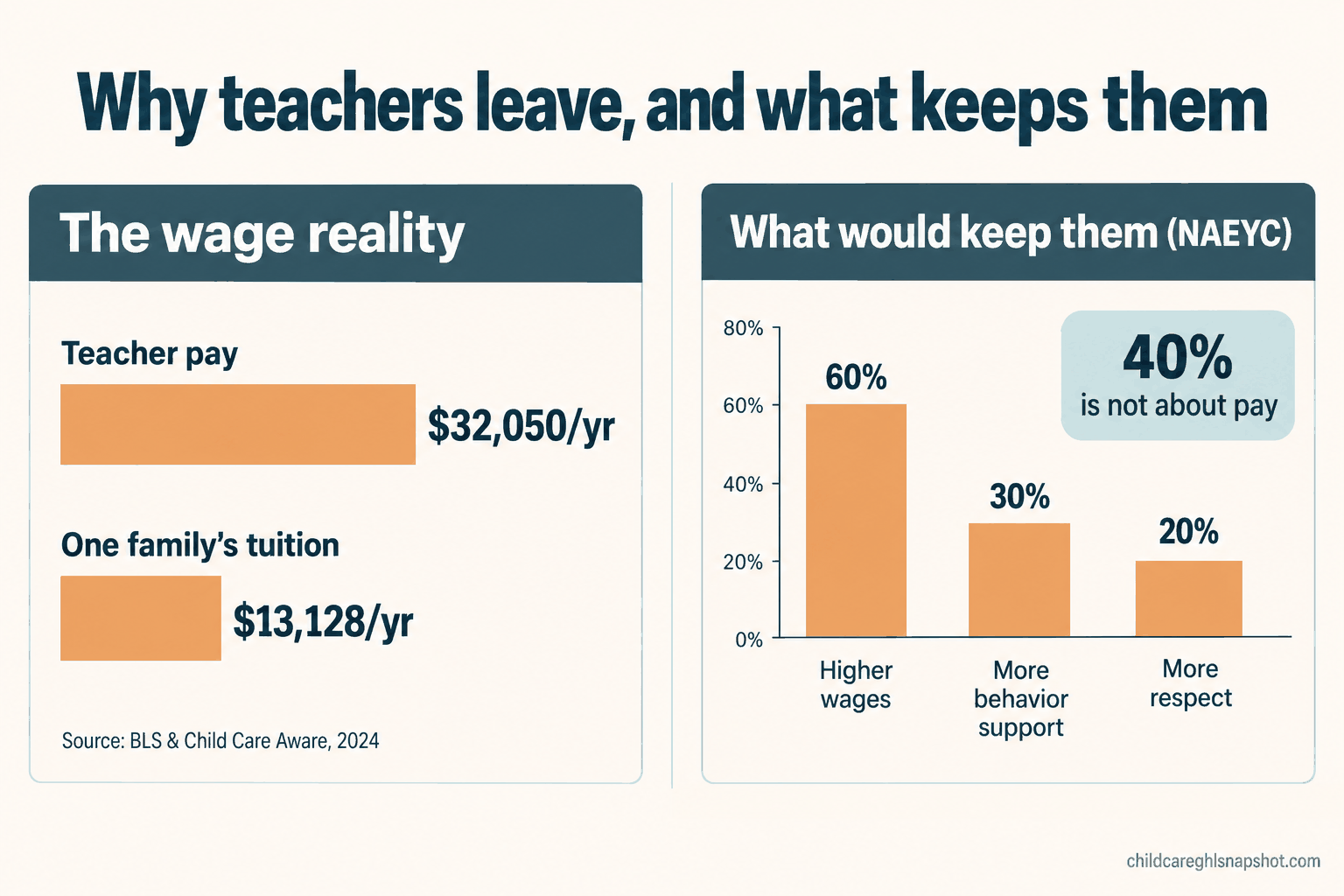
You often cannot move the first bar much, but you can move the other two this week, for free. “More support with behavior” means a director who steps into the room when the biter is having a day. “More respect” means a schedule that treats her time as real, a specific thank-you, and a say about her room. Only one of the real reasons people quit is “you did not pay enough.” The rest are a sink-or-swim first month, a schedule that wrecks a life, no say, burnout, and no future. Those are what this system fixes.
The retention system, start to finish
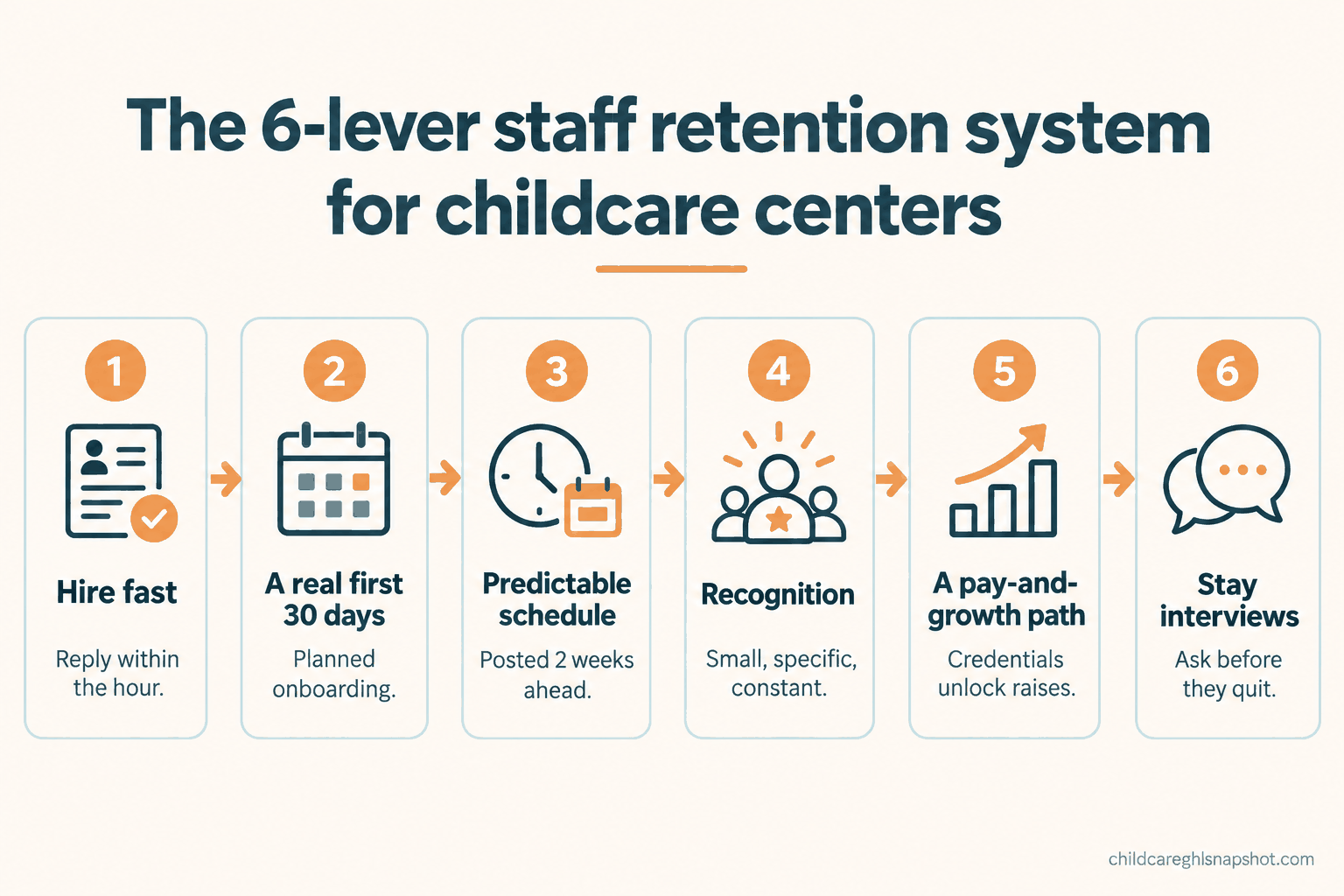
Retention is not a raise you announce once a year. It is a set of moments, from the day someone applies to the day they are thinking about leaving, where most centers do nothing. Here is the first year of a hire.
- ⚡Days 0-3
Hire fast
Reply within the hour, book the interview.
- 🌱First 30 days
Onboard for real
A planned first month, not a room and keys.
- 🗓️Ongoing
Predictable schedule
Hours posted ahead, coverage that is shared.
- 🌟Weekly
Recognition
Small, specific, constant.
- 📈Quarterly
A real path
Credentials that unlock pay and titles.
- 👂Monthly
Stay interviews
Ask before the coat is on.
You do not need software to care about your people, but you do need something to make the caring happen on time. The same tools that text a prospective family back fast can text an applicant back fast and remind you of every work anniversary. Here are the six levers.
Lever 1: Hire fast, or lose the good ones
Speed wins with prospective staff for the same reason it wins with prospective families. A good candidate is applying to you, three other centers, and a retail job that pays the same with no diaper changes, and whoever replies first wins the interview. Treat an applicant like a hot enrollment lead: reply within the hour, with a way to book the interview themselves.
How it breaks. The classic failure is a careers-page form that emails an inbox nobody watches; if a human must notice it first, it will not happen on a busy day, so make the first reply automatic and the booking self-serve. The second is ghosting the people you do not hire, which costs you their referrals in a small local field.
Lever 2: A real first 30 days
More people quit in the first month than you would believe, and rarely because they could not do the work. It is because nobody set them up: a room, a set of keys, and a “let me know if you need anything” from a director who then vanished. A real first 30 days is built once, then runs on a schedule.
How it breaks. The touches feel robotic if they are the only contact, and when the day-14 text asks what would make her day easier, you have to fix the thing she names. And do not hand the “mentor” role to someone who is themselves underwater.
Lever 3: Schedules people can plan a life around
Ask early educators what wears them down and “the schedule” comes up as fast as pay. Not the hours, the unpredictability: shifts that change on Friday, being asked to stay late every time, losing your planning period with no notice. You will never make this a nine-to-five, but you can make it predictable: post it further ahead, spread the “can you stay late” asks so one person is not carrying them all, and build in real coverage so a single call-out does not blow up ratios.
How it breaks. The trap is treating your best, most flexible teacher as free overflow capacity. She says yes because she cares, you keep asking because she says yes, and one Monday she is in your doorway with her coat on. Track who you lean on and spread the load.
Lever 4: Recognition that is small and constant
This is the cheapest lever and the one most centers fumble. “Thank you” means little; “the way you talked that new dad down at pickup Thursday was exactly right, that family is staying because of you” means everything, because it proves you noticed. It fails because directors cannot hold it all in their head while running a building: birthdays, anniversaries, a certification finished, a review naming a teacher. Those slip on a busy week, so put the dates somewhere that pings you and add the human part when it does.
When a happy family names a teacher in a review, that is gold twice: it retains the teacher and it markets your center, the same loop behind turning happy parents into reviews and referrals, pointed at your staff.
Lever 5: A pay-and-growth path without a tuition hike
You cannot fund a bidding war, but “we can’t raise pay” and “there is no way to earn more here” are different sentences, and staff hear the second as a dead end. Tie small, real raises to credentials: a teacher who finishes a CDA or the next level of your state’s credential earns more, on a schedule she sees from day one. T.E.A.C.H. Early Childhood scholarships and WAGE$ supplements exist in many states to raise educator pay and reward staying, so find them through your local child care resource and referral agency before you assume the raise comes out of your margin. Then use the levers that are not cash: predictable schedules, a few paid planning hours, and a title change that signals a future. NAEYC’s own read is that compensation means more than the hourly wage.
How it breaks. A path you describe but never move someone along is worse than none, because now you have made a promise. And watch for quiet inequity: when a loyal three-year teacher learns a new hire negotiated up to her wage, you lose her.
Lever 6: Hear it before it becomes a resignation
By the time someone is in your doorway in a coat, the decision is made. The whole game is to hear the problem while it is still a problem: ask, on purpose, when nothing is wrong. Stay interviews are how. A review looks backward and carries evaluation pressure; a stay interview looks forward, a short, low-stakes check on how the job is actually feeling: fifteen minutes a quarter with each teacher, plus a light monthly pulse for the whole team.
How it breaks. Asking and then doing nothing teaches your team the questions are theater. Only ask what you are willing to act on, then close the loop out loud: “you said X, here is what I changed.”
Run it three ways
The same six levers, sized to your reality.
The solo owner-director (one site, you are also in ratio). You are the HR person, between drop-off and a diaper change. Automate what steals the time: the applicant reply, the onboarding drip, the anniversary reminders, the monthly pulse. Do the stay interviews yourself, because from you, fifteen minutes lands harder than any program. A tight enrollment funnel helps too, because understaffing and under-enrollment feed each other.
The mid-size single site (30 to 90 kids, an assistant director). Split the work: the assistant director owns onboarding and the schedule, you own pay-path talks and stay interviews with leads. Watch float coverage closely, because one unfilled infant-room role under strict ratios can quietly cap your most profitable room. The classroom break-even calculator shows what a half-empty room costs.
The multi-site chain (2 to 3 locations). Your risk is drift: three directors, three ways of treating people, and turnover that spikes wherever someone is winging it. Centralize the system, the applicant flow, the onboarding drip, the recognition prompts, the pulse, and let each director keep the human layer local. A turnover problem at one site is usually a management problem, not a pay problem.
The compliance part you cannot skip
The moment you text staff and applicants at scale, the rules that govern texting parents apply. Under the TCPA and the A2P 10DLC rules that now govern US business texting, an applicant or employee should opt in, every automated message needs a clear way to stop, and you must honor STOP immediately. The plain-English version is in our guide to texting daycare parents legally; the mechanics are the same for staff.
Keep the channels separate, too. Your staff and applicant list is not your parent marketing list and must never quietly become one, and an automation that touches attendance, health, or a child’s records stays in the parent-only channel. One thing operators get backwards: FERPA generally does not apply to a private licensed daycare, so do not lean on it as your rulebook. What binds you is your state’s licensing rules on child-record confidentiality and photo consent, and you can never name or picture a specific child in marketing without consent on file.
The objections I hear from directors
“I can’t out-pay the center down the road, so what’s the point?” Right, you cannot, and that is why the other five levers matter. The big employer with summers off is bad at the calm start, the predictable schedule, and being seen by name. Compete there.
“Isn’t this just soft HR stuff?” It is the hardest-dollar stuff you have. A capped infant room is lost tuition every day it sits short, on a seat a family in a child care desert is desperate to fill.
“Do I really need software for this?” You need something to make it happen on time. A few directors run it on a notebook and real discipline, but most cannot, because the day eats the discipline. Automating the applicant reply, the onboarding drip, and the anniversary ping just keeps the caring from getting skipped on the busy weeks.
“Won’t automated messages feel impersonal to my staff?” They will if you let the automation be the whole relationship. Used right it does the opposite: it hands you the moment (“today is her anniversary”) so you show up human and on time.
Your questions answered
What is a normal staff turnover rate for a childcare center?
Turnover in early care runs high compared with most industries, and it climbs at centers that pay the least. Rather than chase a national benchmark, track your own rate month over month and by role. Infant and toddler leads are the most expensive to lose, because the strictest ratios mean their departure can cap a room right away.
How do I keep teachers if I genuinely can't raise pay right now?
Move the free levers first: a calm, planned first 30 days, a schedule posted far enough ahead to plan around, specific recognition, and stay interviews that actually fix things. In NAEYC's survey, many educators thinking about leaving said more support and more respect would keep them, not only more pay. Then build a credential-based pay path and use state programs like T.E.A.C.H. and WAGE$.
What is a stay interview, and how is it different from a review?
A stay interview is a short, low-stakes conversation, about fifteen minutes a quarter, on how the job feels right now and what would make it better. A review looks backward and carries evaluation pressure; the stay interview looks forward, to surface fixable problems early.
How does staff turnover actually affect my enrollment and revenue?
Two ways. First, ratios: lose the qualified person covering a room and you must cap or close it until you replace her, so every short-staffed day is lost tuition. Second, trust: parents notice a churn of new faces, and continuity of care is tied to better outcomes for children.
Can I text my staff and job applicants the way I text parents?
Yes, with the same rules. Get a clear opt-in, give every automated message a way to STOP, and honor it immediately, under the TCPA and A2P 10DLC. Keep your staff and applicant list separate from any parent marketing list, and never let an automation touching child data feed a marketing audience.
It is a different Monday now. Your float teacher covers the toddler room without you scrambling. The new hire you replied to within the hour is thriving, because her first month was planned instead of survived. And the teacher you thought you were losing said, in her stay interview last week, that what she wanted was not two more dollars, it was to stop being the one asked to close every Friday. You fixed that in an afternoon, and she is still here. The people stay, the rooms stay full, and you never had to raise tuition to do it.
Colleen Brannigan spent eleven years as a center director. She writes about the operations behind a full, well-staffed center.