It is 9:12pm. A mom you have never met is on her couch with a laptop, her toddler finally asleep, and a spreadsheet of daycares open in another tab. She fills out the contact form on your website, then messages your Facebook page too, because she is not sure which one you check. Then she does the same for the two centers down the road. Whoever answers first gets the tour. You find her form at 8:40 the next morning, between a diaper blowout and a staffing call. By then she has booked somewhere else.
Here is the short version. Parents shop for daycare after their own workday ends, which is exactly when your front desk is dark. The fix is not a night-shift receptionist. It is a simple automated system that answers her the second she reaches out, books the tour while she is holding her phone, and hands a warm, booked family to a real person in the morning. This post is that system, stage by stage, with the messages you can copy.
What this post covers
- Why the inquiries you miss all land after you have gone home
- The after-hours response system, stage by stage
- Steal these: the after-hours messages
- Run it three ways: solo, mid-size, and a small chain
- The compliance part you cannot skip
- Objections I hear from directors
- Your questions, answered
Why the inquiries you miss all land after you have gone home
Think about the family actually looking for care. Both parents work. The last thing they can do at 2pm is sit on hold with a daycare, so the search happens at night, after dinner and after the kids are down. That is when forms get filled and voicemails pile up, exactly when your building is empty and your phone rolls to a machine.
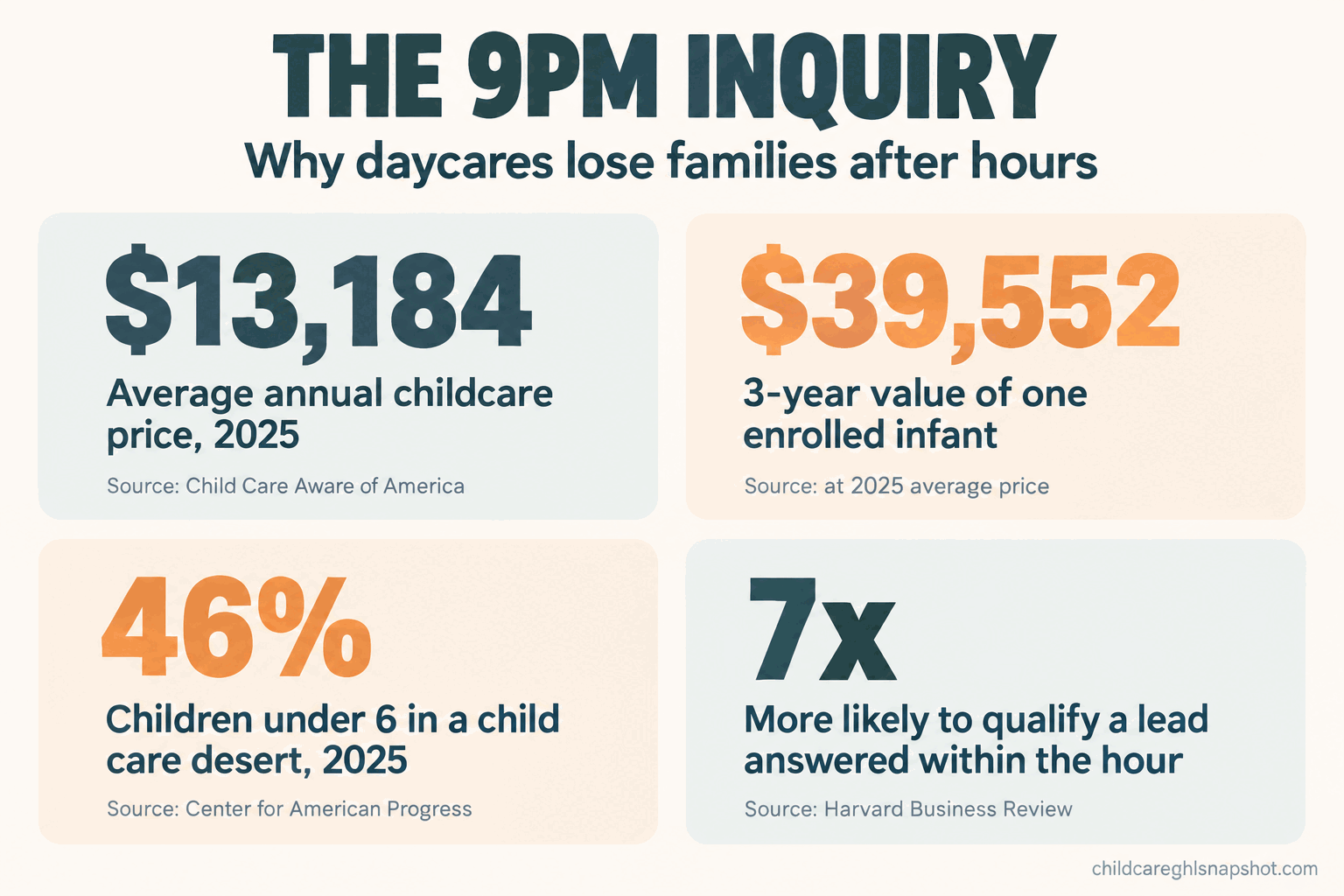
This is not a small leak, because of what one enrolled family is worth. The national average price of child care in 2025 was $13,184 a year, per Child Care Aware of America. A family that enrolls one infant and stays three years is worth $39,552. Every after-hours inquiry left until mid-morning is a shot at that number you let a competitor take first.
Speed is not a tiebreaker, it is the whole game. Harvard Business Review’s study of online sales leads found that answering within an hour made a qualifying conversation about 7 times more likely than waiting even an hour longer, and roughly 60 times more likely than waiting a day. A form that sits from 9pm to 9am is a twelve-hour wait, during which that mom messaged two other centers. Demand is real (about 46% of children under 6 still lived in a licensed child care desert in 2025, per the Center for American Progress), so families are hunting. The only question is who answers them first.
Relative likelihood of a qualifying conversation, indexed so answering a day later equals 1, from Harvard Business Review’s study of online sales leads. An inquiry that sits overnight is on the far right of this chart.
The after-hours response system, stage by stage
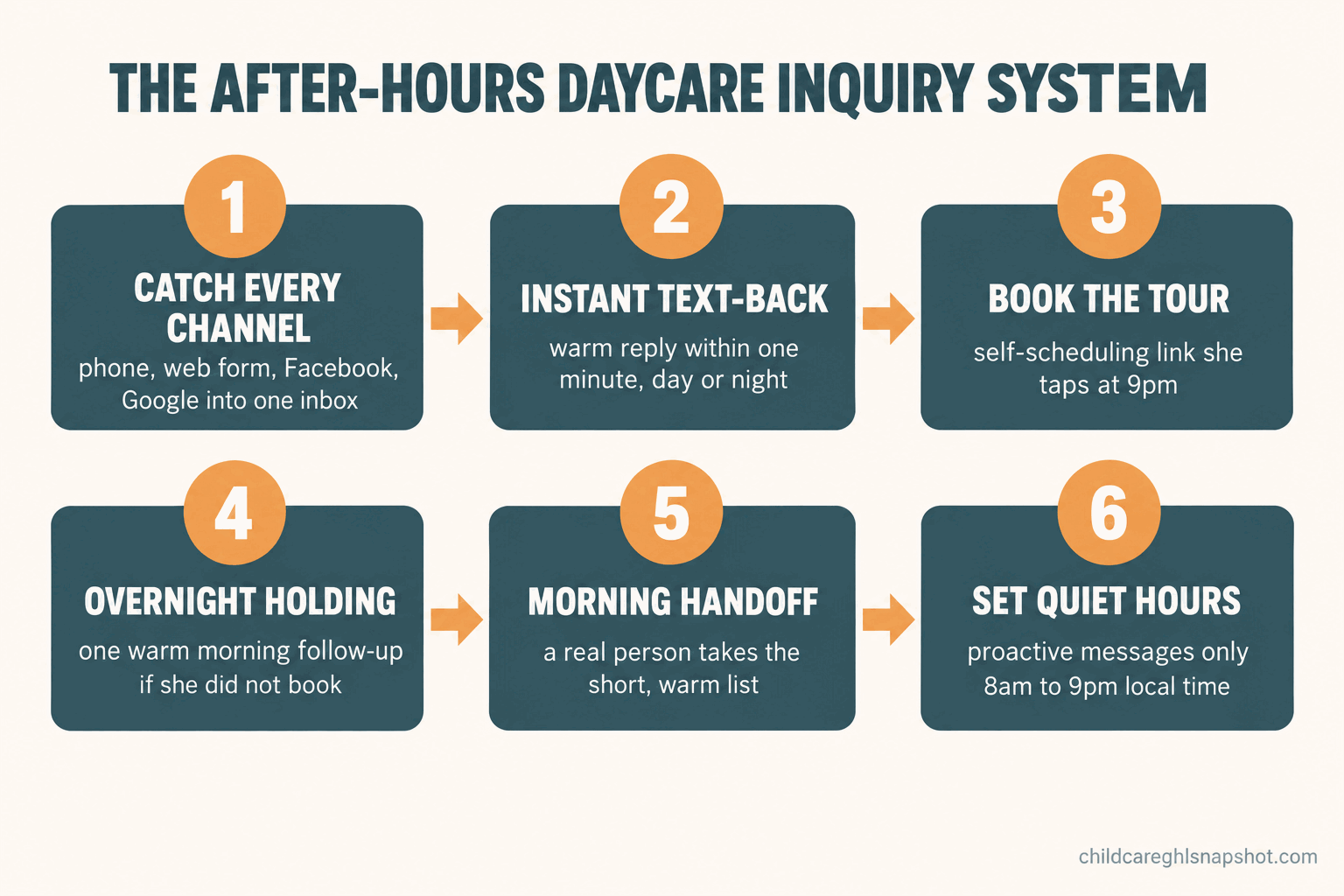
The goal is not to run your center at midnight. It is to make sure the family who reaches out at night feels answered, gets a tour on the calendar, and is waiting for you in the morning instead of enrolled elsewhere. Six stages do that, and once set up they run without you.
Stage 1: Catch every channel in one place
A parent at 9pm does not care which channel you watch. She calls, fills the website form, messages your Facebook and Instagram, and sometimes taps the message button on your Google listing. If each lands in a different inbox checked on a different schedule, half of them die. The first job is to route every channel into one place that can trigger a reply automatically, which is also what fixes turning daycare Facebook messages into booked tours, where the message simply never reaches a human.
How this breaks: The classic failure is a form that emails a general inbox nobody has on their phone after 5pm: technically delivered, functionally lost. The second is a missed call that does nothing. If your phone rolls to voicemail and that is the end of it, you cannot answer, because you do not even have her number yet. Every channel has to feed one hub before you can automate anything.
Stage 2: The instant text-back that buys you the night
This is the center of the whole thing. The moment a parent contacts you, after hours or not, she gets a text back within a minute. If she called and you missed it, the system texts the number that just rang; if she filled a form, it texts and emails her. The message is short and warm and does one job: it keeps her talking to you instead of the next center on her list. A missed-call text-back is the single highest-value automation a center can run, and the direct answer to losing enrollments to whoever calls back first.
How this breaks: A text that sounds like a robot is worse than no text. “Your request has been received, ticket #4471” tells a parent she is talking to a machine, and she goes back to her spreadsheet. Write it like a person did, with your center’s name and a real first name. The other failure is promising what you cannot deliver, like “we will call you right back” at 10pm. Promise the morning instead, and mean it.
Stage 3: Let the parent book the tour while she is holding her phone
A reply is nice. A booked tour is the win. The after-hours text carries a self-scheduling link so the mom on the couch can pick a tour time at 9:15pm without waiting for your office to open. She sees your real availability, taps a Tuesday 10am slot, and gets an instant confirmation. You wake up to a booked tour instead of a lead to chase.
How this breaks: Too many choices freeze people, so offer two good times, not fourteen across three weeks. The bigger failure is a booking with no reminder attached, which quietly becomes a no-show. A tour booked at 9pm for next Thursday needs the reminder sequence from cutting daycare tour no-shows, or you have just automated an empty calendar.
Stage 4: The overnight holding sequence for the ones who do not book
Most parents will not book on the first touch, and that is normal. So the family who replied but did not pick a time gets a short, patient sequence, not silence: a warm follow-up the next morning, then one more a couple of days later if needed. This is the same cadence that carries the daycare enrollment funnel, applied to the hours you were asleep.
How this breaks: Two failures live here. One is doing nothing, so a late-night inquiry with real intent cools off. The other is doing too much, blasting a parent three times before breakfast. One warm morning follow-up, spaced from a second a few days later, is the balance.
Stage 5: Hand a warm, booked family to a real person in the morning
Automation’s job ends when a human’s begins. Your director opens the laptop at 8:30am to a short list: three families who reached out overnight, one tour already booked, two who replied and need a call. The human makes the calls that matter, with the daycare enrollment phone script ready, and the tour gets locked in.
How this breaks: The handoff fails when the morning list lives in five places, so the person has to reassemble it before she can act. It all has to surface in one view, newest first, with the auto-conversation attached so she can see what the parent already said.
Stage 6: Set the quiet hours and the boundaries
An after-hours system is not a license to text families at 2am, so you set the rules once. The instant reply to someone who just contacted you can go any time, because it is a response she triggered. Anything proactive, like a follow-up to a family who did not reply, waits for daytime hours. You also decide what never gets automated: anything about a currently enrolled child, their attendance, or their health stays in your parent app, never the marketing path.
How this breaks: The worst version mixes channels, so a prospecting text and a “your child had a fever today” update come from the same number. Keep the inquiry path and the enrolled-family path separate. The other failure is forgetting local time, firing a proactive follow-up at what is 6am for a parent one time zone over. Set it to the recipient’s local time, daytime only.
Steal these: the after-hours messages
Here is the actual copy. Change the names and program details, keep the length and warmth. Use your director’s real first name, because a parent trusts “Ms. Dana” over “the team.”
Two rules carry this copy: the instant reply always offers both a booking link and a human fallback, and every proactive follow-up gives an easy out, because a family that feels chased does not tour.
Run it three ways: solo, mid-size, and a small chain
The same six stages scale, but what you automate and what you do by hand changes with your size.
How an after-hours system changes with the size of your center
| Plan | Solo (30-50 kids) | Mid-size (60-100 kids) | Small chain (2-3 sites) |
|---|---|---|---|
| Price | Start with 2 stages | Full six stages | Six stages + routing |
| Feature 1 | Missed-call text-back + one self-booking link | All channels into one shared inbox | Central inbox, routed to the right site |
| Feature 2 | Replies go to the director's phone | Automated text-back + booking + reminders | Quiet hours set per location time zone |
| Feature 3 | One morning follow-up, sent by hand | Front-desk lead owns the morning list | Dashboard of after-hours tours per site |
| Feature 4 | Biggest risk: no link, so nothing books at night | Biggest risk: morning list scattered across tools | Biggest risk: two sites texting one parent |
If you are solo, do not build all six stages at once. The missed-call text-back and a single self-scheduling link do most of the work, because they stop the two leaks that cost the most: the dead voicemail and the form nobody answers until mid-morning.
If you are mid-size, this is where the full system earns its keep. You have enough after-hours volume that a human cannot catch it all, and enough that losing it hurts. One shared inbox, an automated text-back and booking flow, and one person who owns the morning list turns a chaotic start into a calm checklist.
If you run two or three sites, it becomes an engine with routing: an inquiry reaches the right location’s calendar and director, quiet hours follow each site’s local time, and a dashboard shows overnight inquiries turned into tours per site. The payoff is real, and so are the stakes, because at that volume carriers watch how you text.
The compliance part you cannot skip
After-hours automation touches two nerves daytime calling does not: the hour you are sending, and the fact that a machine is sending it. Get this right and it protects you.
Quiet hours are real, with one important nuance. Under the TCPA, telephone solicitations, including marketing texts, are generally restricted to between 8am and 9pm in the recipient’s local time, and law firms advise treating that window as the safe boundary for any marketing message. The nuance that makes an after-hours system work: an instant reply to a parent who just contacted you is a response she asked for, not a cold solicitation. Keep proactive follow-ups inside daytime hours and let only the triggered, she-contacted-you replies fire at night. (The FCC has been asked to clarify how consent interacts with quiet hours, so run the conservative rule.)
Register for A2P 10DLC before you send any volume. US carriers filter business texts from ordinary ten-digit numbers unless the business and its campaign are registered through the A2P 10DLC system. Skip it and your instant text-back silently fails to deliver, the whole system failing quietly. Put an opt-out on the first message and honor every “stop” immediately, as the FCC requires. For the full rundown, read can you legally text daycare parents.
Keep enrolled-child data out of the inquiry path. State licensing rules, not FERPA, govern child-record confidentiality and photo consent for a private licensed daycare. Your after-hours flow talks to prospective parents about spots and tours. It must never carry a current child’s name, photo, attendance, or health information, which belong in your parent app or a direct call.
Objections I hear from directors
“Won’t an automated text at night feel cold or pushy?” Only if it reads like a machine. A warm note with a real name, sent because she just reached out, lands as responsive, not intrusive. Parents are relieved someone answered at all, since the two centers down the road left her on read until morning.
“I already pay for Brightwheel or Procare. Doesn’t that handle this?” Those are tools for families already enrolled: parent communication, attendance, billing. They do not answer a brand-new inquiry at 9pm or book a tour for a stranger. This runs beside your check-in app, not instead of it, the honest answer in what childcare software actually costs in 2026.
“Do I need to be technical to run this?” No, but the plumbing has to be set up right once: the channel routing, the text-back, the booking link, the A2P registration, the quiet-hours timing. That part is worth having built for you. After that, your daily job is answering a short morning list of families who are already warm.
“What if a parent books a time I can’t actually do?” The self-scheduling link only shows availability you set, so she can never book a slot you are not open for. It is your real calendar, not an open-ended promise.
Your questions, answered
Is it legal to text a daycare parent back automatically at night?
An instant reply to someone who just contacted you is a response she triggered, which stands on very different footing from a cold marketing text. The conservative rule is to let only triggered replies fire at night, and keep proactive follow-ups inside 8am to 9pm in the parent's local time, the window the TCPA treats as safe for marketing. Always include an opt-out and honor every stop. This is general information, not legal advice.
What is a missed-call text-back and why does it matter so much for daycares?
It is an automation that texts a caller the moment you miss their call, so a parent who rings during nap time or after close hears back within a minute instead of hitting a dead voicemail. The first center to respond usually gets the tour, and most daycare inquiries land during hours your phone is not staffed, which makes it the single highest-value automation a center can run.
Do I need to answer inquiries 24/7 myself?
No, and that is the point. The automation answers instantly and books the tour. You answer in the morning, to a short, warm list of families who already got a reply and often already have a tour on the calendar. You are not working nights, the system is holding the family until you are back.
Will a chatbot or AI assistant replace my front desk?
No. The automation handles the first reply and the booking, which are time-sensitive and simple. The real conversation, the tour, and the warmth that makes a parent choose you stay with a person. It makes sure no inquiry is ignored overnight, it does not replace the humans who close the enrollment.
Won't this annoy parents and get me marked as spam?
Annoyance comes from volume and bad timing: daily texts, long robotic messages, no opt-out, firing at 2am. This does the opposite: one instant response she asked for, one warm morning follow-up, a clear opt-out, and proactive messages only during the day. Registering for A2P 10DLC and keeping complaint rates low keeps your texts delivering.
So picture that 9:12pm again. The mom on the couch fills out your form, and before she can open the next tab her phone buzzes: a warm note from Ms. Dana, a link to book a tour, an offer to call first thing. She taps Tuesday at 10. By the time she messages the two centers down the road, she already has a visit scheduled with you, and they are still dark. You did not stay up and you did not hire anyone. You just made sure the hour families actually shop for daycare is not the hour your center disappears. That is the whole system, and it runs while you sleep.