
It is 5:48pm and a dad is at your front desk insisting nobody told him pickup closes at 6:00 or the fee kicks in. You know it is in the handbook. You also know he signed something on day one, in a stack of eleven forms, holding a car seat and a crying toddler. So now you are the bad guy over $25, the teacher who stayed late is unpaid, and the dad is drafting a one-star review. The policy existed. It just never did its job.
Here is the answer up front. A parent handbook is not paperwork you produce for your licensor and then forget. It is the document that decides who pays when things go sideways: the late pickup, the unpaid invoice, the family that leaves mid-year, the parent who posts a photo of someone else’s child. A vague handbook costs you money and reputation on a slow drip. A clear one, in plain words and actually enforced, protects your revenue, your staff, and your license. This post gives you the eight sections every daycare parent handbook needs in 2026, sample language you can copy, and the part most directors miss: how to make it get followed instead of filed.
What this post covers
- What a vague handbook costs you
- Is a parent handbook even required?
- The eight sections, with copy you can steal
- Run it three ways by center size
- The part most directors miss: enforcement
- Objections and FAQs
What a vague handbook costs you
The seat you lose is expensive to refill. The national average price of care ran about $13,184 a year in 2025, according to Child Care Aware of America, and Care.com’s 2026 Cost of Care report puts the average weekly daycare price at $332. A single seat is roughly fourteen hundred dollars a month walking through your door. When a family leaves in March over a dispute a clear policy would have prevented, you do not lose $25. You lose the rest of that contract.
Average weekly price of care by type in the US, 2026, from the Care.com 2026 Cost of Care report. A center daycare seat is the most valuable thing you sell, which is why the policies that protect it are worth getting right.
The demand is there. Center for American Progress found that 46 percent of children under six lived in a licensed child care desert in 2025. What erodes a center is friction: the fee you cannot collect, the overtime you pay because pickup has no teeth, the family that drifts off because nobody set expectations in week one. The handbook removes that friction before it starts.
Is a parent handbook even required?
For most licensed centers, yes, and the rule is usually specific. In Texas, 26 TAC 746.501 requires written operational policies covering a defined list of topics, and 746.503 requires parents to get a copy and sign an enrollment agreement that includes them before admission. Washington spells out what the written parent policies must include and requires a signed acknowledgment on file. Child Care Aware of America says the same more broadly in its guide to developing your policies. So the handbook is not optional. The only choice is whether yours creates fights or ends them.
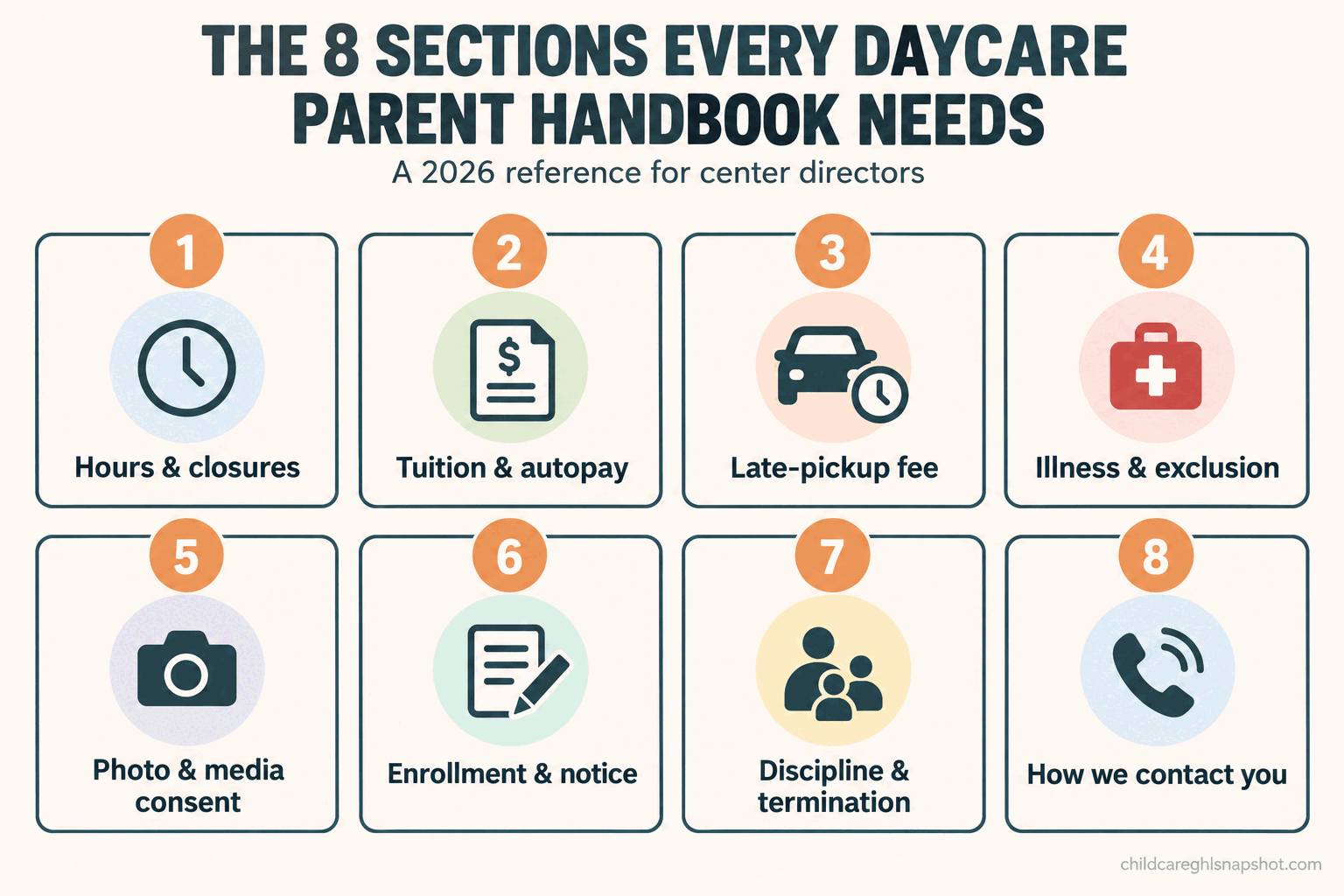
The eight sections every handbook needs
Each section gives you what it is for, sample language you can copy, and the way it breaks when left vague. Change the numbers to match your center and state.
1. Hours, closures, and the calendar
Hours and closures. We are open Monday through Friday, 6:30am to 6:00pm. We close for the holidays listed in your welcome packet and posted in the lobby, plus professional-development days announced 30 days ahead. Tuition is charged in full during scheduled closures, because your child’s spot and teacher are held for you. For a weather or emergency closure we notify you by text and email by 6:00am.
How it breaks. “We observe major holidays” with no dates means a parent shows up on a floating holiday and feels blindsided. Name the dates, and settle the tuition-during-closure question in writing, or every closure becomes a negotiation.
2. Tuition, fees, and autopay
This is the most important money section, and the one directors most often write too softly.
Tuition and payment. Tuition is billed weekly, due each Monday for the week ahead, and charged automatically to the card on file. A non-refundable registration fee of $X and a security deposit of one week’s tuition are due at enrollment. Payments more than 3 days late incur a $X late fee, and accounts more than 10 days past due may have care suspended until current. Tuition is based on your enrolled schedule, not attendance.
How it breaks. “Tuition is due at the start of each week” with no autopay and no late fee is an invitation to pay you late. Put the fee and trigger in writing, then collect on autopay. Our tuition autopay and late-payment recovery guide covers the setup, and the classroom break-even calculator shows why a few missed payments can sink a room.
3. Late pickup and the fee that enforces it
Late pickup is the single most common handbook dispute: it happens often, costs real money in overtime, and can push you out of ratio right at closing.
Late pickup. Our day ends at 6:00pm. A late fee of $1 per minute, per child, applies starting at 6:01pm and is billed to your account on your next autopay. The time is recorded by our sign-out system, not a staff member’s watch. Three or more late pickups in a rolling month may be grounds for review of your enrollment. If we cannot reach you or your emergency contacts within 30 minutes of closing, we follow our posted safety protocol.
How it breaks. “A late fee may apply” fails three ways: no amount, so staff improvise; no trigger time or clock, so every pickup is a debate about 6:04 versus 5:59; and it is billed by hand, so half the time it never gets charged. Write the figure, anchor it to a system clock, and bill it automatically. We go deep in how to handle late pickups.
4. Illness, medication, and exclusion
Parents need to know exactly when to keep a child home and how you handle medication, so the rule is applied the same way to every family.
Illness and exclusion. Please keep your child home with a fever of 100.4F or higher, vomiting or diarrhea in the last 24 hours, or an undiagnosed rash. A child who develops these at school is separated from the group and you are called for pickup within one hour. Children may return 24 hours after symptoms resolve without medication, or with a doctor’s note. Medication is given only with a completed, signed authorization and in the original labeled container. We follow our state licensing and local health guidance on reportable illnesses.
How it breaks. A vague “sick children will be sent home” leaves “sick” to a tired parent who swears it is just teething. Name the temperature, the symptoms, and the return rule, and tie it to your state’s rules rather than your own thresholds. The specific version also protects you from the charge that you singled a family out.
5. Photo, video, and communication consent
This keeps you out of a modern kind of trouble: a child’s face on your Facebook page when a parent never agreed, or one parent filming a room full of other people’s children.
Photos, video, and media. We photograph children for daily reports to their own parents and, separately and only with your written permission, for our marketing (website, social media, printed materials). Marketing consent is optional and requested on a separate form. You may say no, or change your answer anytime, and your child stays fully enrolled; we simply will not use their image publicly. Parents may not photograph or record other children. We never identify a child publicly without written consent on file.
How it breaks. The lazy version buries a blanket photo release inside the enrollment contract, so signing up means agreeing to be on your Instagram. Minnesota, for example, bars providers from sharing a child’s photo, video, or identifying information except to send updates to that child’s own parents who gave written consent (Minn. Stat. 142I.06). Keep marketing consent separate and optional, and make sure your posts can only pull from the yes list.
6. Enrollment, withdrawal, and notice
This decides how much runway you get when a family leaves, and whether your waitlist has time to backfill the seat. The notice period is the whole game.
Enrollment and withdrawal. Enrollment is continuous until you withdraw in writing. We require two weeks’ (14 days’) written notice to withdraw or reduce your child’s schedule. Tuition is charged through the end of the notice period whether or not your child attends. Your security deposit is applied to your final two weeks when proper notice is given, and is forfeited if you leave without notice.
How it breaks. No notice period means a family can tell you Friday that today was the last day, and now you carry an empty seat you did not see coming. Two weeks is the floor; many centers use a month. Tie the deposit to the notice so there is a reason to give it, and make the first thirty days deliberate, because families who leave in year one usually decided in week two. Our new-family onboarding sequence is built around that window, and why good families quietly leave covers the signs.
7. Discipline and termination of care
This is the section nobody wants to write and everybody needs. It protects children, protects staff from accusations, and gives you a defensible process if you ever have to disenroll a family.
Guidance and termination. We use positive guidance: redirection, clear and consistent limits, and age-appropriate natural consequences. We never use physical punishment, withholding of food, or shaming, consistent with our state licensing standards. We may terminate care, with notice where safety allows, for non-payment, repeated failure to follow handbook policies, abusive conduct toward staff or children, or when we cannot safely meet a child’s needs. Before terminating for behavior, we will meet with you to build a support plan first.
How it breaks. With no written discipline policy, every incident is handled differently and you have no ground to stand on when a parent complains. Spell out your approach, the hard noes that match your licensing rules, and the termination grounds and process. The goal is not to disenroll families, it is to have a fair path for the rare time you must.
8. How we contact you
Text is how parents actually want to hear from you, and it is governed by rules you need to respect. This section records your channels and gets consent.
Communication and text consent. Our main channels are text and email. By providing your mobile number and checking the consent box, you agree to receive calls and texts about your child and your account, including reminders, closures, daily reports, and billing notices. Reply STOP to opt out of texts anytime; opting out will not affect your child’s enrollment, and we will reach you by phone and email instead.
How it breaks. Texting parents without recorded consent is a trust problem and a legal one. Marketing and promotional texts in particular are governed by the Telephone Consumer Protection Act, where the FCC has required prior express written consent for automated marketing messages, so collect consent in the handbook rather than assume it. One clear consent box and an easy opt-out keeps you clean. We lay out the whole thing in can you legally text daycare parents.
Run it three ways by center size
The same eight sections apply at every size, but the handbook looks different at each.
The solo or home-based provider (up to ~12 children). Your risk is being too informal with families you know personally. Tuition, late pickup, and notice matter most, because you have the least cushion. Keep the handbook short, but keep the money sections sharp, and let the written policy be the “bad guy” so you do not have to be.
The single center (30 to 150 children). Here enforcement consistency matters more than wording. With a rotating front desk, the risk is a clear policy applied five different ways depending on who is at the desk. You need the eight sections in full, a signed acknowledgment from every family, and a system that applies fees and reminders identically every time.
The multi-site chain (two or more locations). The risk is drift between sites: one charges the late fee, another never does, and a transferring family feels whiplash. Use one master handbook, location addenda only for hours and local licensing, and centralized billing and messaging.
The part most directors miss: enforcement
A policy that depends on a human remembering to enforce it gets enforced about half the time, and parents learn fast which half. The late fee only works if it is charged every time by a clock nobody argues with. The tuition due date only works if the card is charged automatically.
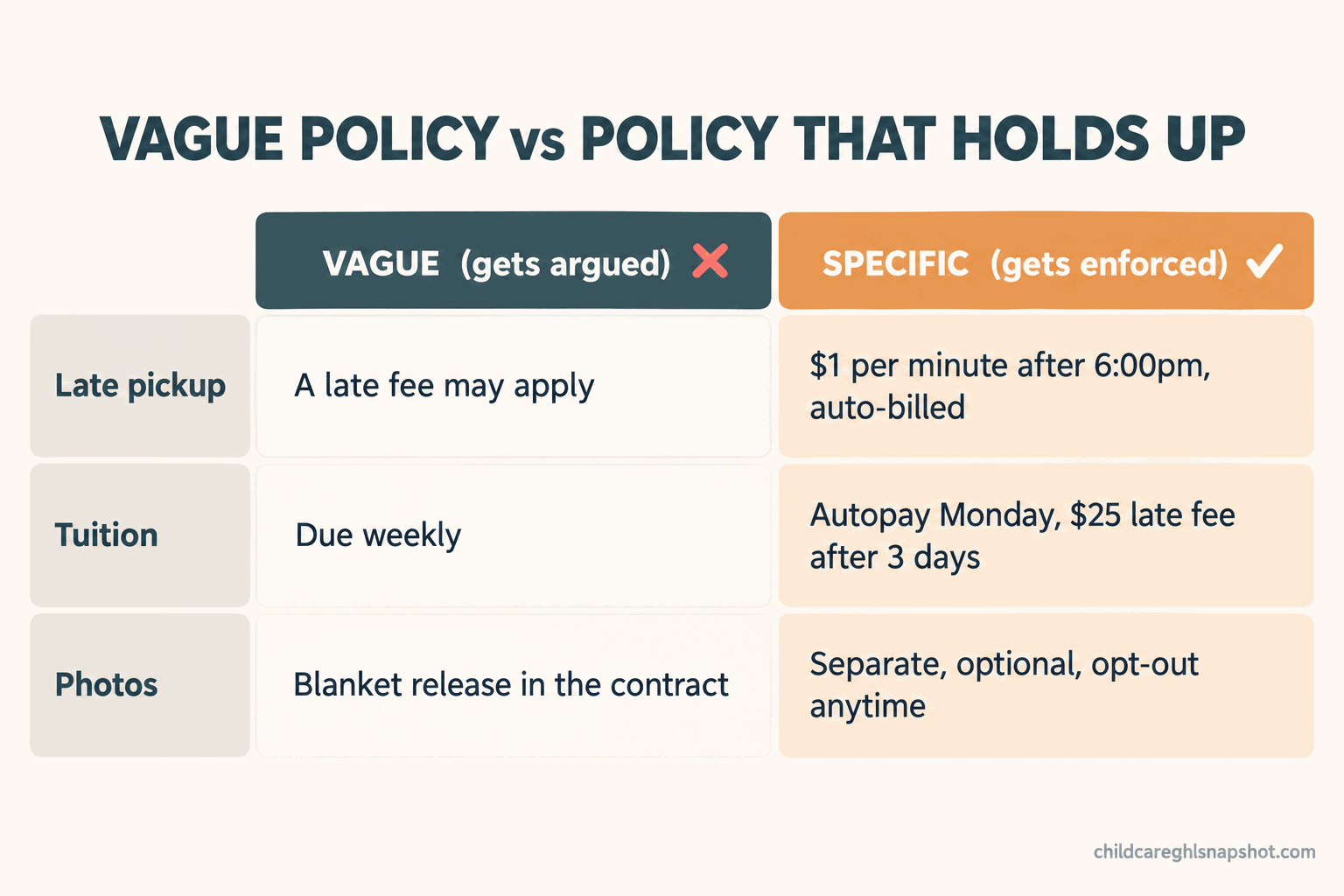
That is the difference between a handbook that is a document and one that is a system. The words set the expectation; the system makes it true without you being the enforcer at 6:00pm. When the pickup clock, the late fee, the autopay, and the text consent all run themselves, the handbook stops being a thing you argue about. That is the point of writing it down: so you never have to say it twice.
Objections answered
“My families are friendly, a strict handbook feels cold.” The handbook is what lets you stay friendly. When the fee is written and automated, you are not demanding $25, the policy is. You get to be warm because the document is firm.
“Won’t a long handbook scare parents off?” Length is not the problem, surprise is. Parents are not scared by a clear two-week notice rule; they are scared by finding it in March when they tried to leave in February. A plain, specific handbook reads as competence, not as a trap.
“I already have a handbook, do I need to redo it?” Audit, not redo. Check every money and safety policy for a specific number, a specific trigger, and a way it is enforced automatically. If “a late fee may apply” or “tuition is due weekly” with no mechanism is in there, those lines are costing you money.
“What about parents who never read it?” Most will not read all of it, which is why the acknowledgment signature and the system matter more than the prose. You cannot make parents read page six, but you can make the autopay charge and the pickup clock run whether they read it or not.
Frequently asked questions
Is a parent handbook legally required for a daycare?
In most states, yes. Licensing standards generally require written operational policies that parents receive and acknowledge before enrollment. Texas requires it under 26 TAC 746.501 and 746.503, and Washington spells out required contents under WAC 110-300-0450. Check your own state licensing standards for the exact list.
How specific should a late pickup policy be?
Very. Name the dollar amount per minute, the exact time it starts, who keeps the clock (a sign-out system, not a staff member's watch), and that it is billed automatically to the account. 'A late fee may apply' is unenforceable and gets argued at the door every time.
Can I require parents to agree to photos as a condition of enrolling?
The safe and recommended practice is no. Keep marketing photo and video consent separate from the enrollment agreement and optional, and make sure a child whose parents opt out can still enroll fully. Some states, such as Minnesota under Minn. Stat. 142I.06, restrict sharing a child's image without written consent. Confirm your own state's rule.
Do I need written consent to text parents?
Collect it in the handbook to be safe. Marketing and promotional texts are governed by the TCPA, which has required prior express written consent for automated marketing. Everyday messages a parent requests, like a pickup reminder or their own child's daily report, sit in a lighter category, but one clear consent box with an easy STOP opt-out keeps you clean. See our guide on texting daycare parents legally.
How often should I update the handbook?
Review it once a year, and any time your tuition, hours, or state licensing rules change. Re-issue it and collect fresh acknowledgment signatures on any material change to fees or policies, so a parent cannot say they only agreed to the old version.
So back to that dad at 5:48pm. In the center that fixed this, he is not arguing, because the fee is already on his account, billed by the sign-out clock, exactly as the handbook he acknowledged on day one said it would. Nobody is the bad guy, because nobody had to be: the policy did its own job. That is what a real handbook buys you, a center that runs on written rules instead of your memory.