
You booked the Procare demo to get one number, and forty minutes later you still do not have it. The rep walked you through check-in, the parent app, the subsidy billing. Then you asked what it costs and heard “let me put together a quote for your program.” You hung up with a follow-up email and no idea whether this fits your budget, while the two-year-old room is short a teacher and a waitlist family is still waiting on your call back.
Here is the straight answer so you do not have to sit through another call to get it. Procare is a capable, deep piece of childcare management software, and for a center with messy billing or multiple sites it is often the right pick. But it will not publish a price, and the number you get on the call is not the number you actually pay. The real cost lives in three places the demo skips: the fees folded into your first invoice, the cut Tuition Express takes on every tuition payment, and the add-ons that turn the base plan into the plan you need. This post lays out what operators really report paying in 2026 and how the math changes by size.
What this post covers
- Why Procare won’t show you a price
- What Procare actually costs in 2026
- The costs that live inside the quote, not on the page
- Three real budgets: solo, single-site, and multi-site
- Steal this: the demo-call script that forces a real number
- Who Procare is actually right for
- Where the money really leaks (and it is not the subscription)
- A word on compliance before you automate anything
- Your questions, answered
Why Procare won’t show you a price
Go to Procare’s site and try to find a number. You cannot. The pricing link opens a request-a-quote form, and Procare’s own article titled “How much does Procare cost” talks about value and plans without ever naming a dollar amount. This is not an oversight. It is the model.
Quote-gating does two things for the vendor. It lets a sales team size you up and quote to what they think your program will pay, rather than a flat published rate. And it buries the comparison, because you cannot line up Procare against Brightwheel against Playground when you are only allowed to see one of the three prices. For a director already covering a classroom, the real cost of that is your time. To its credit, Procare does promise no setup fees and no contracts and no per-child billing, real points in its favor, though a stance on a blog post is not a line in your agreement, so you still have to get the number yourself.
What Procare actually costs in 2026
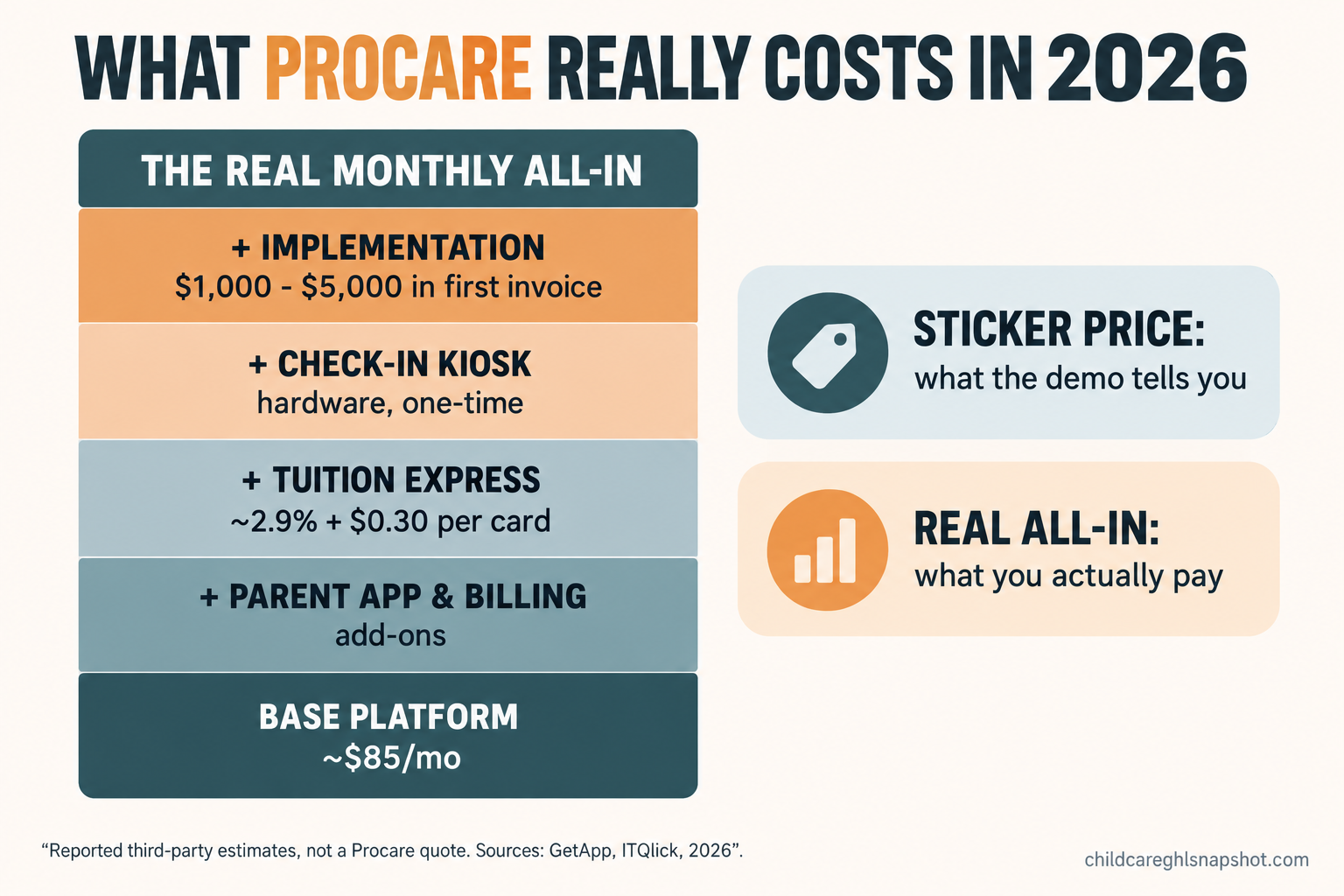
Because Procare will not publish a number, everything below comes from third-party listings and operator reports, not from Procare. I have labeled every figure reported for that reason. Do not walk into a call quoting these as fact. Use them to know roughly where you should land and to catch a quote that is way off.
Procare prices in modules on a monthly plan, with monthly or annual billing. The shape operators describe is a base platform plus add-ons for the pieces most centers actually want: the parent-messaging app, the payments portal, and a physical check-in kiosk.
| What you are buying | Published? | What operators report | Where it comes from |
|---|---|---|---|
| In-home / small program tier | No, quote-gated | Reported ~$25 / month | GetApp |
| Licensed-center base platform | No, quote-gated | Reported ~$85 / month base | GetApp |
| Realistic all-in, small center | No | Reported ~$100-150 / month with parent app + billing | Operator reports |
| Payments add-on (Tuition Express) | No | Reported from ~$25 / month | SaaSworthy |
| Check-in kiosk hardware | No | Separate line item, buy the device | Procare hardware page |
| Setup / contract | Yes | None, per Procare’s own site | Procare |
The base platform is not the product you saw in the demo. The demo had everything turned on; the base plan is just the engine, and the parent app, the payment portal, and the kiosk are often add-ons that stack on top. This is why “about $85 a month” turns into a realistic $100 to $150 for a small center once the parent-facing features are live. Procare holds a solid 4.6 stars across more than 2,800 Capterra reviews, so people get value, but they pay for the stack, not the base.
The costs that live inside the quote, not on the page
The monthly sticker is the part the rep will eventually tell you. The total cost of ownership is the part you dig for, and where most surprises live. Here are the four that catch directors out, and how each one breaks.
“No setup fee” does not mean no onboarding cost. Procare says it does not assess a setup fee, and that onboarding, staff training, and data migration are “figured into your initial cost.” That is not the same as free. The work is folded into your first invoice instead of shown as a separate line. Independent total-cost-of-ownership analysis from ITQlick has estimated implementation and migration for a smaller operation at roughly $1,000 to $5,000. So your first month can run several times the monthly rate, and because it is baked in rather than itemized, you may not see it coming. Ask for the first invoice broken out, in writing, before you sign.
Tuition Express is a second subscription in disguise. Procare runs tuition through its own processor, Tuition Express, and takes a cut of every card payment. Neither company publishes the rate, and reviewers consistently describe the card fees as higher than average. Card processing across the industry commonly runs around 2.9% plus 30 cents a transaction, with bank transfer (ACH) much cheaper. On $40,000 a month in tuition, a rate near 2.9% is more than $1,100 every month, far more than the software itself. This is the single biggest number in the whole deal and it is never on a slide. Ask for the card rate, the ACH rate, and when fees are withdrawn.
The kiosk is hardware you buy, not software you rent. Procare sells physical check-in kiosks as a separate purchase. Some centers love a dedicated device at the door; others run check-in on a tablet they already own. Either is fine, but know which one your quote assumes, because a hardware line can quietly add a few hundred dollars up front. Same with annual billing: Procare keeps its “no contract” promise on monthly, but the annual discount is a soft lock-in by another name, so take it on purpose, not because it was the default on the order form.
Estimated annual subscription at a 60-child center, before processing fees. Playground uses its published $2.00/student/month flat rate ($1,440/yr); the Procare figure uses a reported ~$150/month all-in ($1,800/yr), not a quote, and excludes Tuition Express processing, which for most centers is the larger cost. Sources: SaaSworthy, GetApp.
Three real budgets: solo, single-site, and multi-site
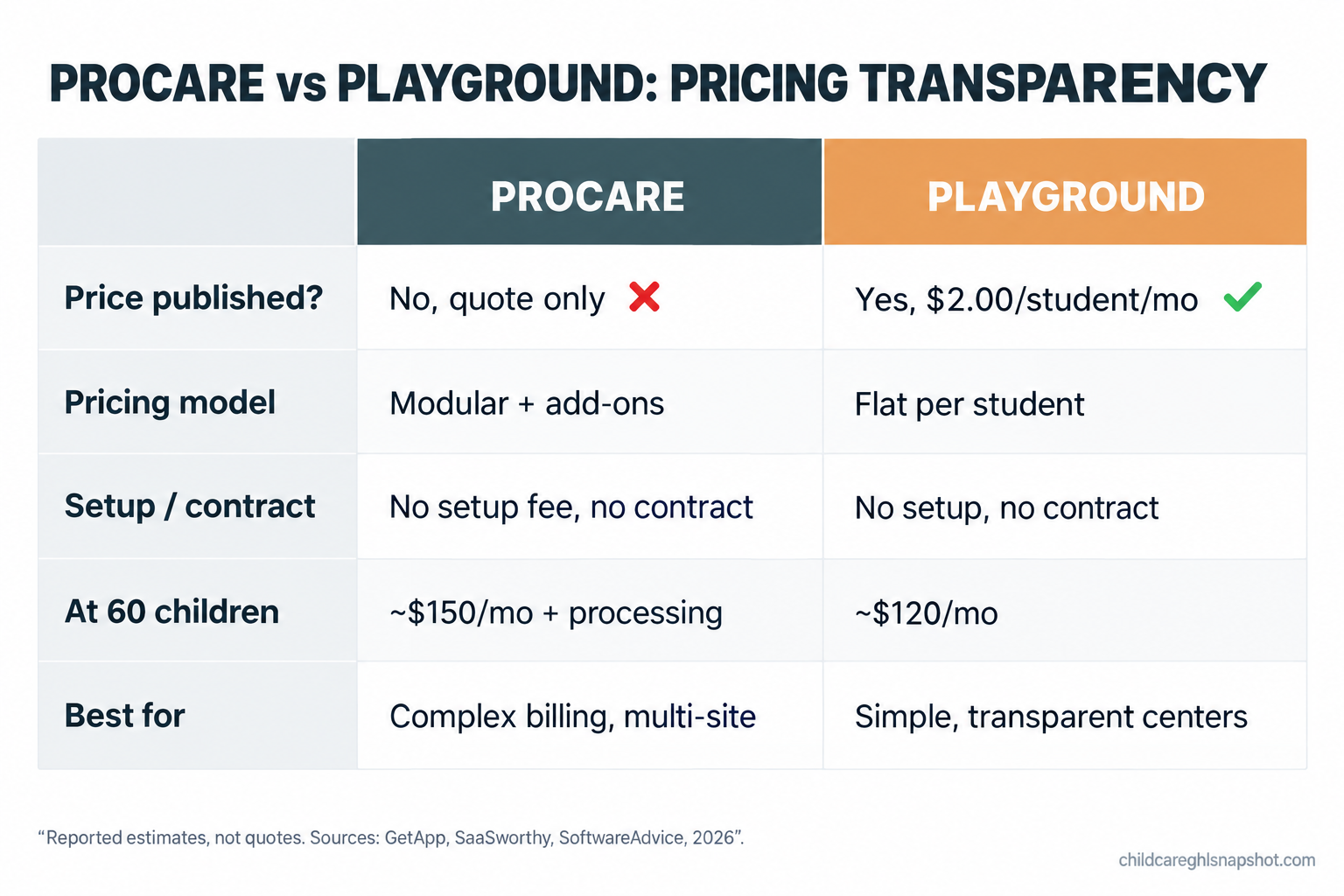
The right answer depends almost entirely on your size, because Procare’s depth is worth very different amounts at different scales. The figures below are the reported estimates above, illustrative, not quotes.
The solo operator (home daycare, about 12 children)
At twelve kids, Procare’s in-home tier near $25 a month is fine, and the depth you are paying for (subsidy reconciliation, multi-site reporting) is depth you do not need yet. At this size almost any tool works and the price gaps are a few dollars. What actually threatens a home daycare is not billing, it is missing the inquiry that came in while your hands were covered in finger paint, and no management app solves that.
The single center (about 60 children)
This is where Procare’s modular pricing starts to matter. The base plan plus the parent app plus billing lands in the reported $100-150 range, and then Tuition Express processing stacks on top of your tuition volume. Compare that against a flat tool: at 60 children, Playground’s published rate is about $120 a month and does not change based on which modules you switch on. If your billing is simple and mostly private pay, Procare’s depth may be more than you need; if you take subsidy and run co-pays that change mid-month, that depth is worth paying for. Price both against your actual roster, not the monthly number that sounded fine on the call.
The multi-site group (about 150 children across locations)
Here Procare earns its keep. Consolidated financials across locations, subsidy reconciliation, and real accounting are what it was built for, where cheaper flat tools feel thin. Expect a quote that reflects the scale, and expect the implementation line (folded into your initial cost) to be real, because migrating two or three sites of billing history is a genuine project. This is also where the enrollment gap hurts most: a multi-site group lives or dies on keeping every location’s waitlist moving, a completely different system from the one tracking nap times.
Steal this: the demo-call script that forces a real number
Since Procare will not publish a price, you have to extract it. Copy these into your notes and ask them in order on the demo. They surface the hidden costs before you are sold on the parent app, and get the whole thing in writing.
- “Which features are in the base plan, and which are paid add-ons? List every add-on and its monthly price. I do not want to find out the parent app or the payment portal is extra after I sign.”
- “For a center my size, [X] children, what is the all-in monthly total with the parent app and billing turned on?”
- “What is the exact card-processing rate on tuition through Tuition Express, and what is the ACH rate? When are those fees withdrawn?”
- “You say no setup fees. What is in my first invoice specifically? Does it include onboarding, training, or data-migration cost, and how much?”
- “Is there any hardware cost for check-in, or can it run on a tablet I already own?”
- “What is the monthly price on monthly billing versus annual, and is annual a discount or a commitment?”
- “If I leave, can I export all my child records, billing history, and parent contacts myself, at no charge?”
- “Everything you just told me, can you put it in an email today?”
That last one does most of the work. A number a rep will put in writing is a real number. A number they will only say out loud is a starting position in a negotiation you did not know you were in.
Who Procare is actually right for
I am not here to talk you out of Procare. It is a deep, mature tool, and for the right center it is the correct choice. Pick it if you take state subsidy, run sliding-scale co-pays, or split bills between households and are tired of patching those cases by hand, or if you run more than one site and need consolidated financials your bookkeeper can use. That billing depth is Procare’s home turf, where simpler app-first tools break.
It is probably more than you need if you run one mostly private-pay center with simple billing and want to be live this week rather than after a real onboarding. There, a flat-rate tool like Playground costs less and frustrates your teachers less. For the whole category side by side, our childcare software pricing teardown covers every vendor; against Brightwheel specifically, the Brightwheel vs Procare comparison runs that head-to-head; and if the quote comes back high, there are enrollment tools that show their price upfront worth a look.
Where the money really leaks (and it is not the subscription)
Here is the honest part. Everything above, Procare and every tool it competes with, is childcare management software: attendance, daily reports, billing, and messaging for families already enrolled. It does not do the thing that actually decides whether your center makes money, which is turning an inquiry into an enrolled family.
That matters more than the software line, because the demand is usually already there. The Center for American Progress found 46% of young children live in a licensed child care desert as of 2026, so families in most markets are looking and the bottleneck is follow-up. Industry reporting in 2026 suggests parents tour roughly 3.2 centers before deciding, so the family that filled out your form at 9pm is comparing you to two or three others. With the national average price of care at $13,184 a year per Child Care Aware of America, every seat you lose on a slow callback is real money. Procare does not call that family back. No management app does.
A word on compliance before you automate anything
One thing no pricing page mentions but every center has to get right: the rules on automated messaging. If you text parents, through Procare, Tuition Express reminders, or any enrollment system, two federal rules apply. The TCPA governs consent for automated texts, and A2P 10DLC is the carrier registration business texting now requires in the United States. In plain terms, get a clear opt-in before you text a family and register your number, or your messages start getting filtered out. We cover the specifics in can you legally text daycare parents.
On child records, clear up one myth a vendor might use on you. FERPA, the school-records law, generally does not apply to private licensed daycares, so do not let anyone scare you with it. Your real obligations come from your state’s licensing rules on child-record confidentiality and on photo and video consent, which you cannot make a condition of enrollment. Never name or show a specific child in marketing without consent on file, and keep any automation touching attendance or billing data in the parent-only channel, never feeding your marketing list.
Your questions, answered
How much does Procare cost per month in 2026?
Procare does not publish a price. Third-party reports put the in-home tier near $25 a month and a licensed-center base near $85, landing around $100 to $150 all-in with the parent app and billing on. Those are estimates, not quotes. The bigger cost is the unpublished Tuition Express processing fee, which should be your first question on the call.
Does Procare really have no setup fees or contracts?
Yes, and it is true. The catch: onboarding, training, and migration are, in Procare's words, figured into your initial cost, so the first invoice runs higher than the monthly rate. Independent analysis has estimated implementation at roughly $1,000 to $5,000 for a smaller operation. Ask for the first invoice itemized in writing.
What is Tuition Express and how much does it cost?
Tuition Express is Procare's built-in payment processor for tuition. Neither company publishes the rate, and reviewers often report card fees higher than average. Industry card processing commonly runs near 2.9% plus 30 cents per transaction, with ACH cheaper. On $40,000 a month in tuition, that is over $1,100 monthly, usually more than the software.
Is Procare worth it for a small single center?
It can be, but it may be more than you need. Its strength is complex billing (subsidy, co-pays, split accounts) and multi-site accounting. For one mostly private-pay center with simple billing, a lighter or flat-rate tool costs less and sets up faster.
How does Procare pricing compare to Playground?
Playground publishes a flat $2.00 per enrolled student per month, no setup fee and no contract, so at 60 children it is about $120 a month. Procare is quote-gated and modular, with add-ons plus Tuition Express on top. Playground wins on transparency; Procare wins on billing depth.
Will Procare help me fill my empty spots?
No. Procare runs attendance, billing, daily reports, and messaging for families already enrolled. It does not answer a new inquiry fast, chase a tour no-show, or nurture a waitlist. That is a different system. The Childcare Snapshot is a one-time $997 GoHighLevel setup built for exactly that, running alongside Procare rather than replacing it.
So, back to that quote sitting in your inbox. Before you reply, do three things. Ask the eight questions above and get the answers in an email. Find the Tuition Express rate and multiply it by a month of your tuition, because that is the real number. Then divide the all-in monthly by your enrollment and compare it to two dollars a head. You have every right to know what you are paying before you pay it, especially in a sector that runs on margins this thin. A vendor that gives you a straight number in writing is showing you how the rest of the relationship will go.